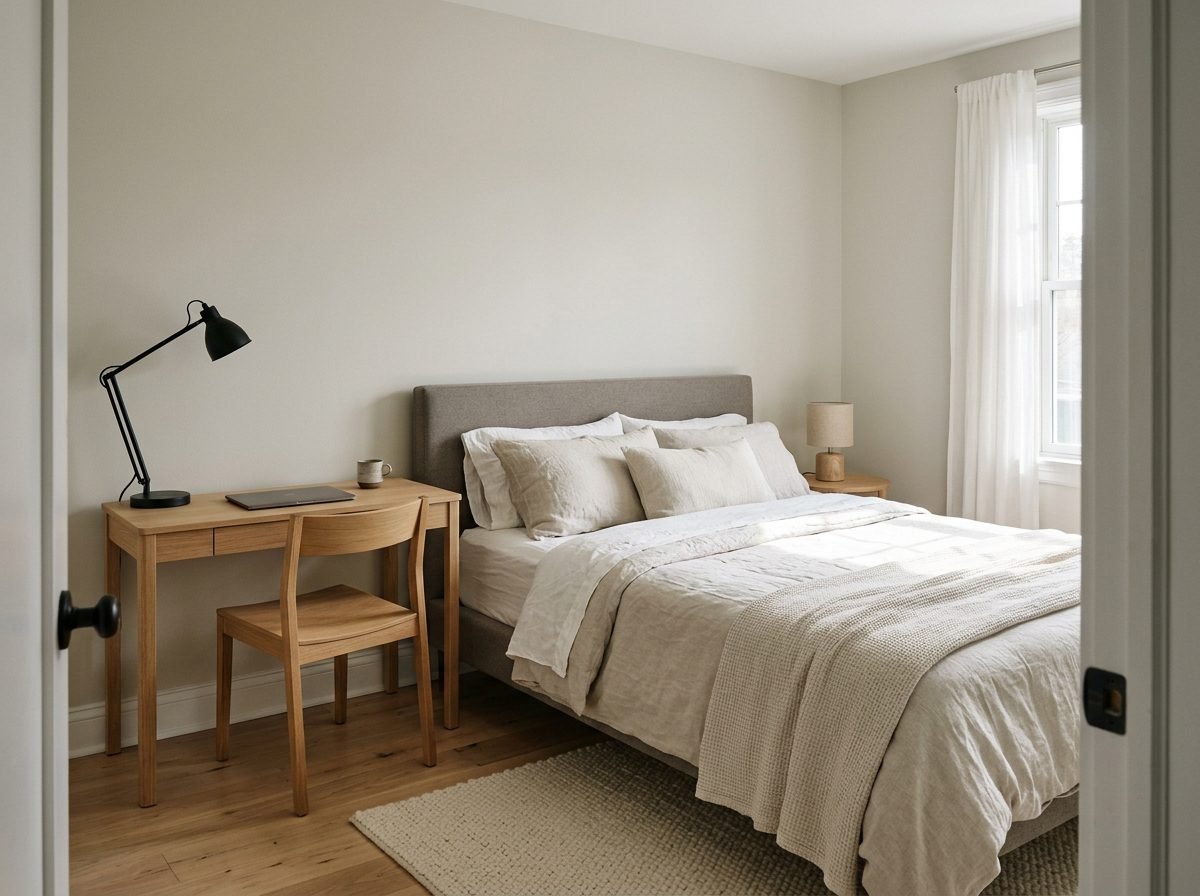
How to Fit a Desk in a Small Bedroom Without Losing the Bedroom
A desk in a small bedroom has two jobs that pull against each other. It has to work well enough for hours of focus. It also has to fade out of the room when you want to sleep. Most advice covers only the first job. It shows a pretty corner desk and stops there.
This guide covers both. You’ll find where to put a desk in a small bedroom, how much floor it really takes, which sizes fit and how to make the work corner disappear at night. The numbers here are planning guides, so measure your own room before you buy anything.
The best spot for a desk in a small bedroom is one you can’t see from your pillow, like the headboard wall, a closet or a corner beside the headboard. Plan about 30 to 36 inches behind the desk for the chair, keep a clear path to the door and choose a desk you can clear at night.
Where should a desk go in a small bedroom?
A desk should go where you can’t see it while lying in bed. That one rule settles most placement questions in a small room. When you lie down, your eyes land on the wall at the foot of the bed and the walls just beside it. Anything on the headboard wall sits behind you or at the edge of your view.
The reason is simple. A desk you can see from bed keeps work in front of you at the end of the day. A laptop, a stack of mail and a task lamp all read as unfinished business. The same desk placed beside the headboard drops out of view once you’re under the covers.
Use the sightline rule first. Then check two practical limits. The chair needs room to pull out, and the path from the door to the bed has to stay open. A spot that passes all three tests is a good spot. A spot that fails only the sightline test can still work, but you’ll need a plan for hiding the desk at night.
| Your room | Desk placement that usually works |
|---|---|
| Bed on one wall with free space on one side | Beside the bed, on the headboard wall |
| Window on a side wall, not facing the bed | Under the window |
| Reach-in closet with sliding or bifold doors | Inside the closet |
| Long room with space past the foot of the bed | At the foot of the bed, facing away from it |
| No free floor left at all | A fold-down wall desk |
How much floor space does a bedroom desk need?
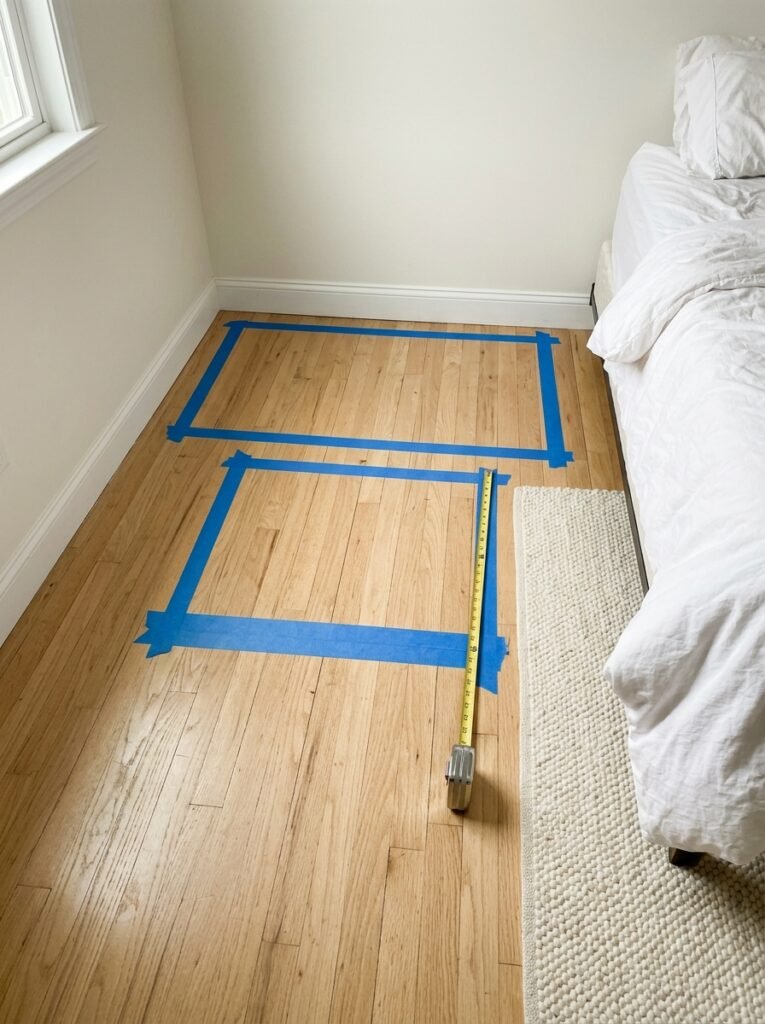
A bedroom desk needs more floor than its own footprint. Plan for the desk plus a chair zone of about 30 to 36 inches out from the front edge. That’s a common planning range for pulling a chair back and standing up without bumping the bed or a dresser.
Next, check the walkway. A path of about 24 inches is tight but passable for one person. Something closer to 30 inches feels comfortable. If the chair zone and the path to the door overlap, you’ll shove the chair in every time someone walks by.
Painter’s tape makes this easy to test. Tape the desk outline on the floor. Then tape the chair zone behind it. Live with the tape for two or three days. If you keep stepping into the chair zone on the way to bed, change the plan before you spend any money.
Five desk placements that work in a small bedroom
Each placement below solves a different room problem. Pick the one that matches your room’s shape and doors, not the one that looks best in a photo.
Beside the bed, in place of a nightstand
A desk next to the headboard can double as your bedside table. It sits outside your view from the pillow, and it uses a spot that would hold furniture anyway. A desk about 30 to 36 inches wide often fits where a large nightstand would go.
The trade-off is that work sits right next to sleep. Keep the corner nearest the bed clear for a water glass, glasses or a book. Everything work related lives on the far side. Before you commit, sit on the bed and check that you can reach that near corner comfortably.
Under the window
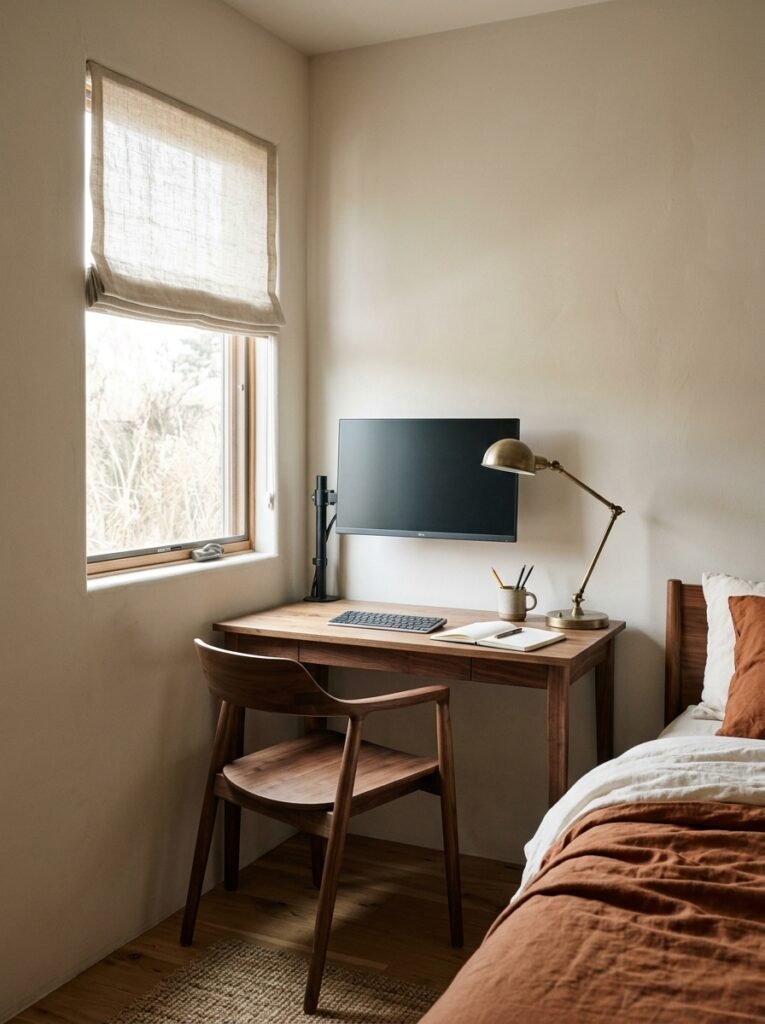
A desk under a window gives you daylight on your work and a better view than a blank wall. It works best when the window is on a side wall, so the desk stays out of view from bed.
Glare is the catch. A bright window directly behind your screen makes the screen hard to read. A window directly behind you can throw light onto it. Setting the desk so the window sits to one side usually avoids both. If the desk must face the window, a sheer curtain or a light-filtering shade softens the contrast at midday.
Check what’s under the sill, too. A radiator or a floor vent can take the space your knees need.
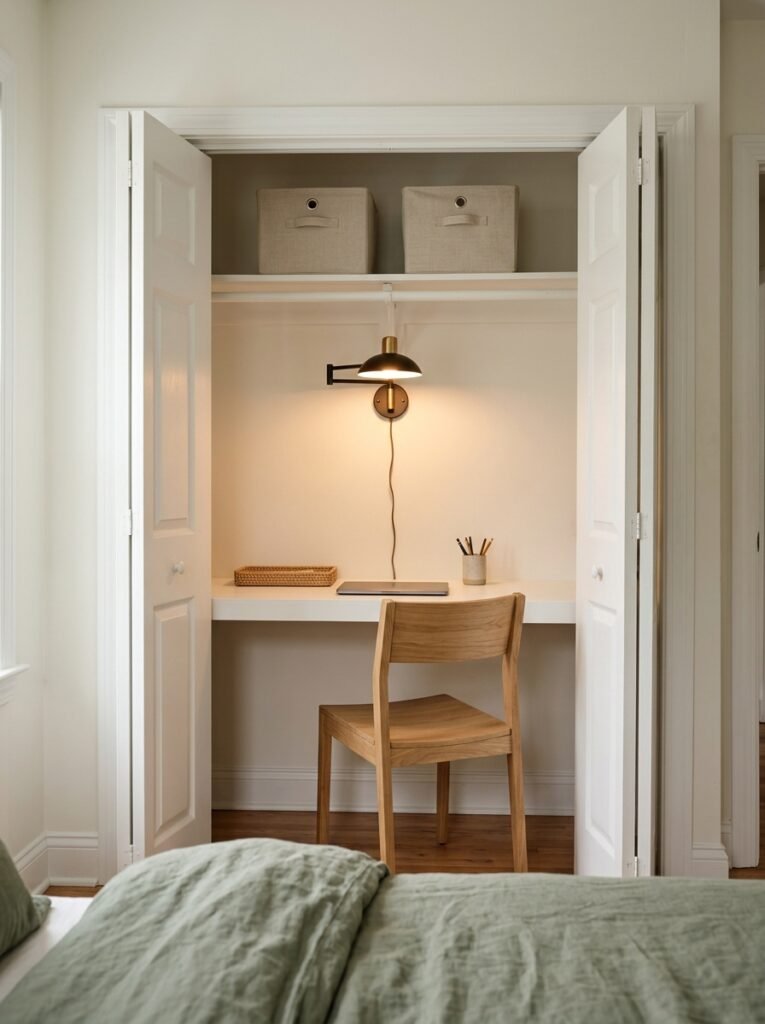
Inside the closet
A reach-in closet can hold a compact desk, and the doors close over the whole setup at night. That makes the closet the strongest option for hiding work. It also costs you hanging space, so it only makes sense if a dresser or wardrobe can take your clothes.
Reach-in closets are usually shallow, so the desk will be shallow too. That suits a laptop better than a large monitor. You’ll also need light, since closets rarely have a fixture where you’d sit. A plug-in or rechargeable wall light avoids new wiring. If you need an outlet that isn’t there, hire a licensed electrician rather than running a chain of extension cords.
Sliding or bifold doors suit a closet desk better than hinged doors. Hinged doors need swing room, and the chair zone usually takes it.
At the foot of the bed, facing away
In a longer room, a desk can sit at the foot of the bed with your back to the bed while you work. This placement fails the sightline test, since the desk is in full view when you lie down. Make up for it with a low desk, a top you clear every night and closed storage for papers.
It also needs length. Add the bed length, the desk depth, the chair zone and the walkway. If the total is longer than the room, skip this one. And if you take video calls, the bed is your background, so make it each morning.
Folding down from the wall
A fold-down wall desk takes almost no floor when it’s closed. It suits rooms where the bed and storage already claim every foot of floor. Decorumy’s look at the benefits of multi-purpose furniture makes the honest point about pieces like this: they only earn their place if you actually fold them away.
Mount a wall desk into studs, or use anchors rated for the load, and follow the maker’s instructions. Renters should check the lease or ask the landlord before drilling. If drilling is off the table, a narrow freestanding console used as a desk is the no-holes version.
What size desk fits a small bedroom?
For laptop work, a desk about 30 to 40 inches wide and 18 to 24 inches deep fits most small bedrooms. Thirty inches holds a laptop and a mouse. Forty inches adds room for a lamp and a notebook. Most desks are made about 28 to 30 inches tall, which suits most adults with an ordinary chair.
A separate monitor changes the math. OSHA’s guidance on computer monitor placement gives a preferred viewing distance of 20 to 40 inches from your eyes to the screen. On a very shallow desk, a monitor can end up closer than that. A monitor arm clamped to the back edge, or a screen mounted on the wall, gains distance without a deeper desk.
The chair matters as much as the desk. An armless chair slides fully under the desktop at night. Many office chairs with arms don’t, so they sit in the walkway. For short sessions, a stool that tucks away completely takes even less room.
Finish matters for a different reason. A wood or painted desk that relates to your bed frame or dresser reads as bedroom furniture. A desk in tones that suit your bedroom color scheme blends in further. Black laminate and chrome legs tend to read as office equipment, even in a soft room.
How do you hide a desk at night?
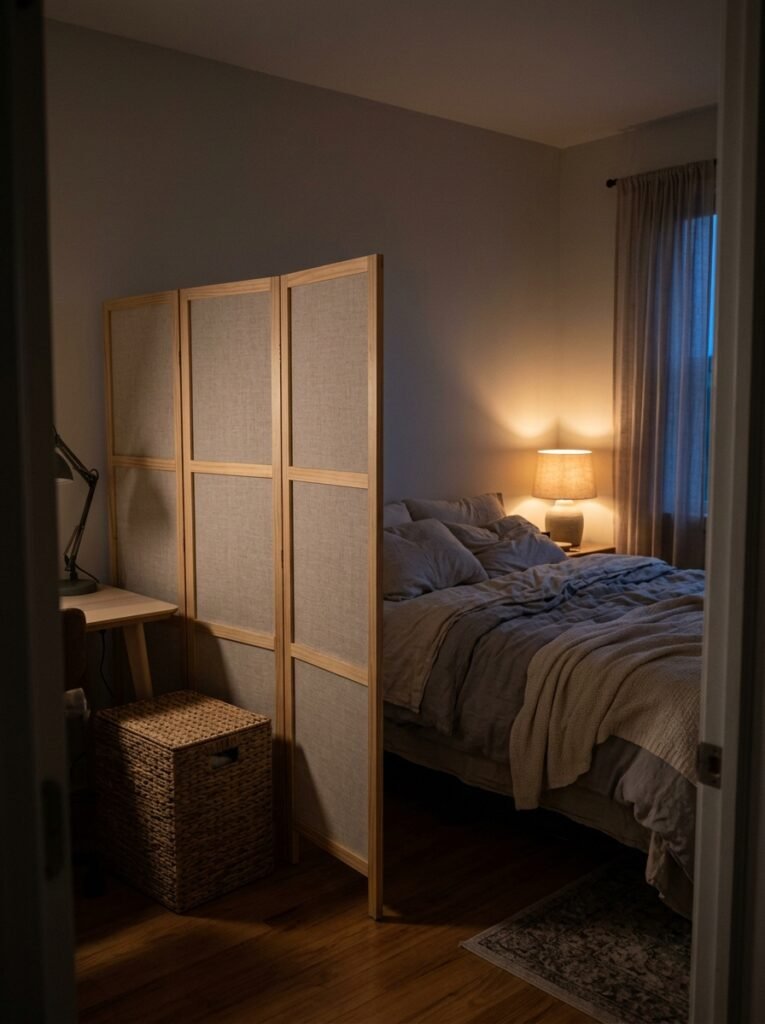
You hide a bedroom desk by clearing the surface and covering what stays. The goal isn’t perfection. It’s a room where nothing on view says “work” after a set time each evening.
Give the work gear one home. A single lidded box, a drawer or a basket holds the laptop, charger and notebooks at the end of the day. One container is easier to keep up than a system of five. Run cables through a tray screwed or clipped under the desktop so they don’t hang down in view.
Then cover what you can’t put away. Here are the options, from least to most effort:
- A folding screen stands in front of a desk in the open, and it needs no tools.
- A curtain on a tension rod closes off a closet desk or a desk in an alcove.
- A curtain on a ceiling track works across a wider corner if you can drill.
- Closet doors do the job on their own, which is the main reason the closet option is so strong.
Put your decorating energy where your eyes go, too. If the desk sits behind you, the wall at the foot of the bed is what you see each night. Our guide to bedroom wall decor for the wall you actually look at covers how to plan that wall.
How should you light a desk in a bedroom?
A bedroom desk should have its own task lamp, separate from the bedside light. When the desk lamp goes off, the workday ends with it. A lamp with an adjustable arm can aim light at the desktop without lighting up the bed.
Keep the two lights different in character. The desk lamp can be bright and focused for daytime work. The bedside lamp works well with a warm bulb, around 2700K, for softer evening light. Avoid relying on one bright ceiling fixture for both jobs, since it can’t do either well.
Screens are the harder part. The Sleep Foundation’s sleep hygiene guidance suggests a device-free buffer of 30 to 60 minutes before bed. It notes that phones, tablets and laptops are mentally stimulating and give off blue light. A desk in the bedroom makes that buffer harder to keep. Pick a time when the laptop closes and the desk lamp goes off, and treat it as the end of the work zone.
What mistakes make a bedroom feel like an office?
The most common mistake is facing the desk toward the bed. You look at the bed all day while you work, and you look at the desk all night while you rest. Turn the desk so your back or side faces the bed instead.
Buying office-style furniture is the second. A mesh task chair, a black desk and a metal filing cabinet can make a small bedroom read as a workplace. Pick pieces in finishes that match the rest of the room where you can.
Using only the overhead light is the third. It leaves the desk in shadow and the bed under glare. A task lamp and a bedside lamp fix both.
Letting the chair become a clothes rack is the fourth. A chair piled with laundry blocks the walkway and the desk at the same time. If clothes keep landing there, the room probably needs a hook or a hamper near the desk.
Stacking storage tall without anchoring it is the one with real safety stakes. A hutch, bookcase or shelving unit beside a desk can tip if it isn’t secured. The Consumer Product Safety Commission’s Anchor It! campaign urges anchoring furniture such as bookcases and dressers to the wall. Do it in any home, and especially where children live or visit.
Quick answers about bedroom desks
Is it bad to have a desk in your bedroom?
A desk in your bedroom isn’t bad if you keep work and rest visually separate. Problems usually come from a desk you can see from bed, work spreading onto the mattress or screens used right up to bedtime. A clear end time, a separate desk lamp and a desk that can be cleared or covered at night handle most of it.
Can I put a desk at the foot of my bed?
You can put a desk at the foot of the bed if the room is long enough for the desk, the chair zone and a walkway. Sit with your back to the bed while you work. Because the desk will be in view from your pillow, keep it low, clear it every night and use closed storage so papers don’t sit out.
What kind of chair works best for a desk in a small bedroom?
An armless chair that slides fully under the desk works best in a small bedroom. It disappears at night and keeps the walkway open. If you work long hours and need an adjustable office chair, measure its arm height against the underside of the desk first. A chair that can’t tuck in will live in your path.
How can I make a desk work in a rental bedroom without drilling?
A freestanding desk, a narrow console or a desk inside an existing closet all work without drilling. Use a tension rod curtain to cover a closet or alcove desk, and a folding screen for a desk in the open. Clip-on or rechargeable lamps avoid new wiring. Ask your landlord before mounting anything to the wall.
Should a desk face the wall or the window in a bedroom?
A desk works best with the window to one side rather than directly in front of you or behind you. Facing a bright window makes a screen hard to read, and a window behind you can cause glare on it. Facing a wall is fine if the window sits to your left or right.
What is the smallest desk that still works for a laptop?
A desk about 30 inches wide and 18 inches deep is a practical minimum for laptop work with a mouse. Narrower surfaces can work for short sessions, but they leave no room for a lamp or notebook. If space is tighter than that, a fold-down wall desk gives more surface for less floor.
Close the laptop, then check the view from bed
A desk in a small bedroom works when the room still feels like a bedroom at 10 p.m. Before you buy anything, tape out the desk and chair zone, lie down and look. If you can’t see the work corner, you’ve found the spot. If you can, choose a placement with a door, a curtain or a clear-off routine you’ll actually keep