Bedroom Wall Decor Ideas for the Wall You Actually Look At
Almost every list of bedroom wall decor ideas starts above the headboard. That is the wall seen for about four seconds a day, on the way in and on the way out.
The wall people genuinely look at is the one facing the bed. In most bedrooms it holds a television, a wardrobe door, or nothing at all. The good art hangs behind everyone’s head. Fixing that one habit changes a bedroom more than any single purchase.
A Bedroom Has Three Views, Not Four Walls
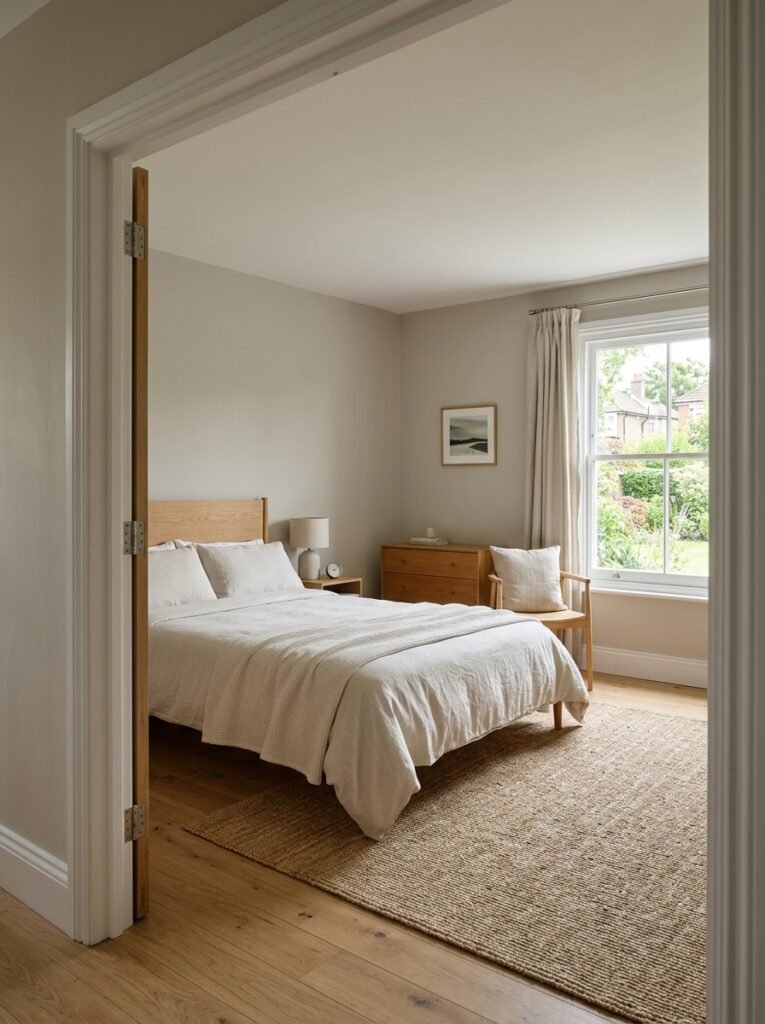
A bedroom gets used from a very small number of fixed positions. That is what makes it different from a living room, where people move around and see everything from several angles.
There are three views worth designing for:
- The doorway view. Standing, taking in the whole room. Short but frequent, and it is the view every photograph is taken from.
- The pillow view. Sitting up or lying down, facing the opposite wall. This is where the most hours are spent by a wide margin.
- The night view. Waking at two or three in the morning, with only streetlight or a hallway light in the room.
Before hanging anything, lie on the bed for two minutes with the phone face down. Note what is in the field of vision. Most people are surprised by how little of the room they can actually see. The visible part is usually the plainest.
Everything behind the bed only exists in the doorway view. That does not make it unimportant. It does mean it should not get the whole budget.
The View From the Doorway
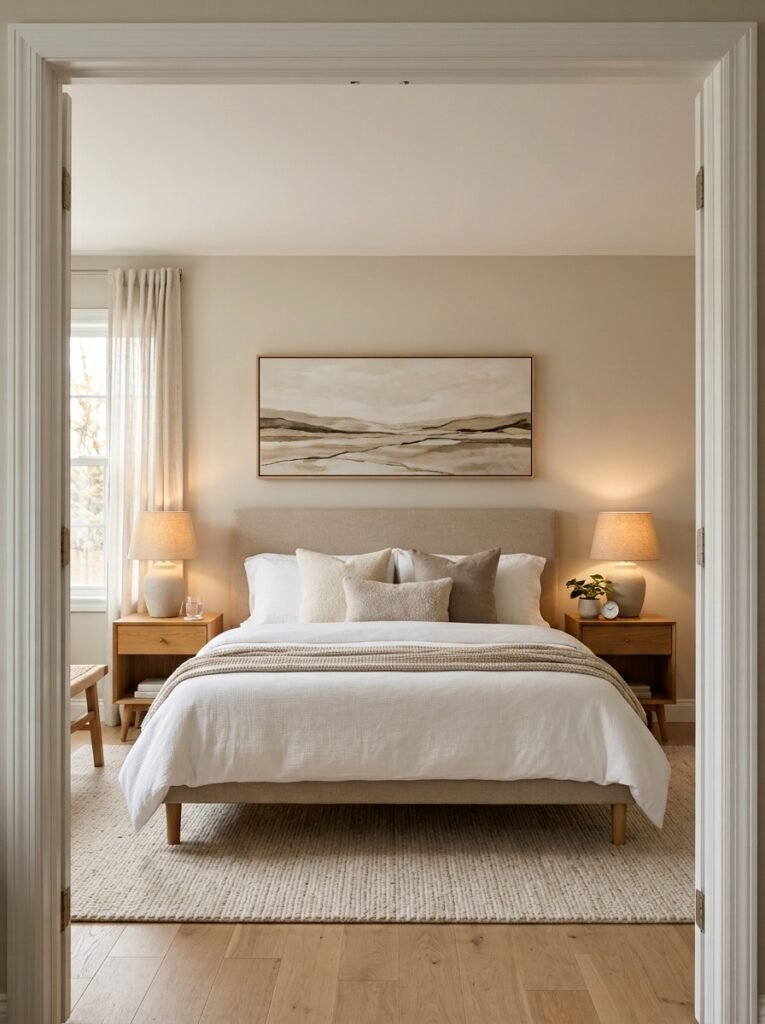
This is the headboard wall, and the bed already dominates it. What matters here is proportion rather than the art itself.
Whatever hangs above a headboard should read as part of the bed, not float on its own. Width is the thing to get right. One wide piece, or a group spanning a similar width, beats something small and narrow over a queen bed. A stamp on an envelope is the usual result.
Leave the top third of the wall alone. Art that climbs toward the ceiling pulls the eye up and makes the ceiling look lower. That is the opposite of restful.
Symmetry is the low-risk route here: matching lamps, matching nightstands, one centred piece above. Asymmetry works, but only when something on the other side balances it, such as a tall plant or a wardrobe.
Gallery walls above a bed are the setup most likely to go wrong. A busy grid sits directly behind a resting head. The composition problems are worth understanding first. This piece on why a gallery wall can end up feeling busy is a useful starting point.
There is also a perfectly good option that costs nothing. Leave the headboard wall empty and let the bed be the feature.
The View From the Pillow
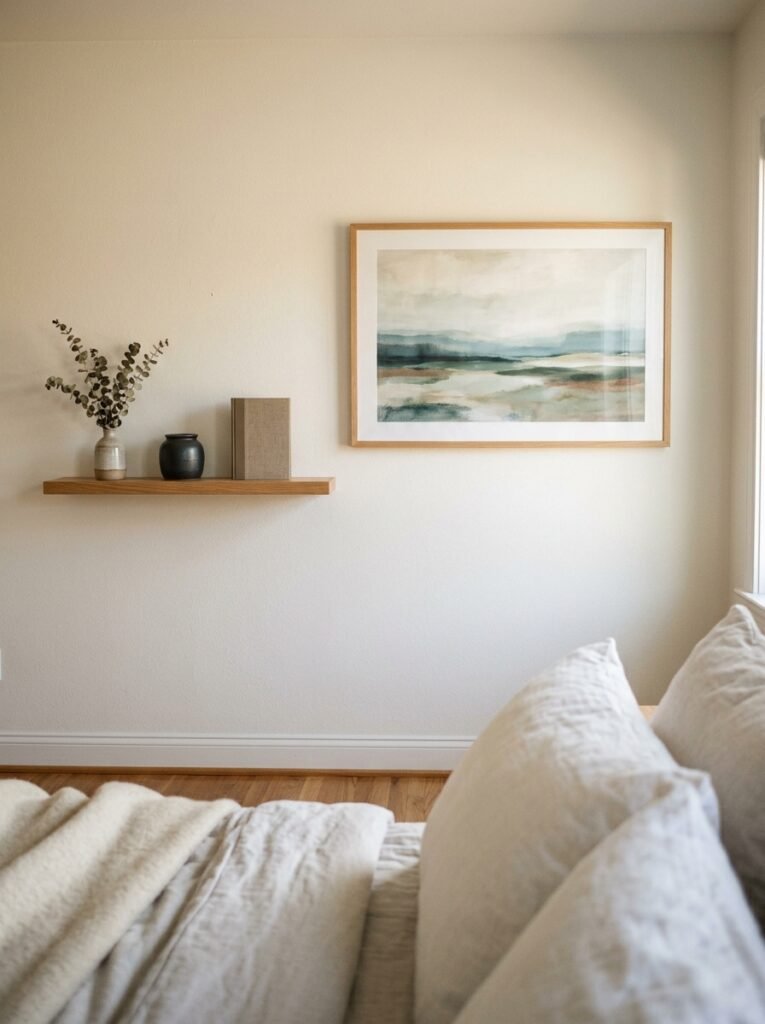
This is the main event, and it is the wall most bedrooms neglect entirely.
Sit on the bed in a normal position and note the rectangle of wall visible without turning your head. That rectangle is the canvas. Everything outside it is decoration for guests.
Height works differently here. From a lying or half-sitting position, anything hung low disappears behind the footboard or the end of the mattress. On this wall, hang higher than instinct suggests and check it from the pillow rather than from standing.
What suits this wall:
- One large, calm piece with nothing to read or decode at eleven at night
- A shallow shelf holding a few objects that get swapped out through the year
- A textile or woven hanging, which softens sound as well as the look
- A picture rail or ledge, so prints can be changed without new holes
Three things tend to fail here. Fine detail that invites study, anything glazed that mirrors a phone screen, and a bare television alone on the wall.
Scale is easier on this wall than above a bed, because there is usually furniture underneath to measure against. A dresser, a bench or a low bookcase gives the art a width to relate to.
If a television lives there, absorb it into the composition instead of fighting it. A darker wall colour behind it, a shelf either side, or a frame around it all help. Pretending it is not there does not. The same applies to a wardrobe on that wall. Decorate the doors, or paint them the wall colour so they recede.
The View at Three in the Morning
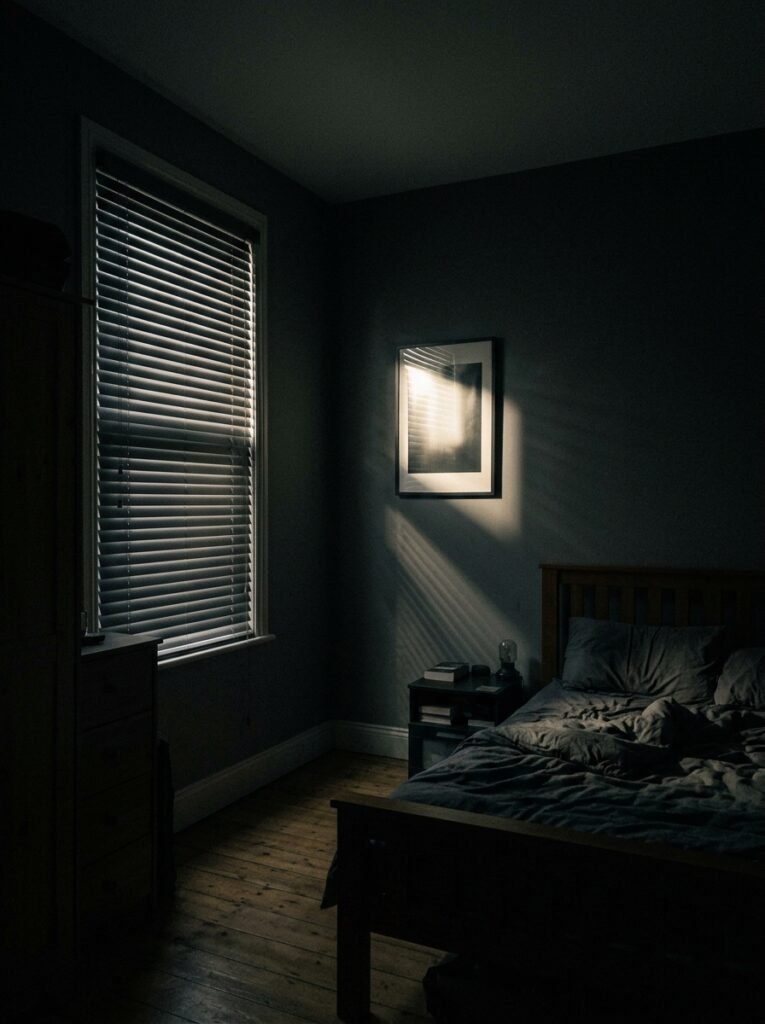
Wall decor has a night shift, and almost nobody plans for it.
Glass and gloss are the main culprits. A glazed frame or a mirror opposite a window catches streetlight and passing headlights. It becomes a bright rectangle at the exact moment nobody wants one. Matte finishes, unglazed prints and fabric stay quiet.
Mirror placement is worth ten seconds of thought. Angle a mirror so it does not bounce the window or a hallway light back toward the pillow.
Large dark shapes above the bed also read differently in low light than they do in a daytime photograph. Some people find a heavy dark canvas overhead restful. Others find it looming. There is no correct answer, only a preference worth testing before committing.
Anything with a standby light counts too. A lit clock, a smart display or a charging dock is wall decor with a light source in it.
The test takes a minute. Turn the lights off, sit up in bed, and look around the room before anything gets fixed permanently.
Short Answers to the Questions That Stall People
How big should the art above a bed be? Aim for roughly two thirds the width of the bed. A queen is 60 inches wide, so a piece or group spanning about 40 inches usually looks right.
Do both sides of the bed have to match? No, but something has to balance the weight. Two identical lamps is the easy version. A lamp on one side and a tall plant on the other does the same job.
Can a mirror face the bed? Practically, the question is what it reflects at night and whether that bothers you. Some people also avoid it for cultural or personal reasons, which is a perfectly good reason on its own.
What works in a rental? Adhesive hanging strips carry real weight limits, so check the rating and stay well under it. Leaning a large framed piece on a dresser needs no holes at all. A picture ledge does the same job.
How many pieces is too many? If the room takes more than a couple of seconds to read from the doorway, it is too many.
What about the ceiling? Paint is the only sensible option overhead. Nothing should be hung above a bed that could come down.
Heights and Sizes That Stop Looking Wrong
Most bad hanging comes from using living room rules in a bedroom. Here the furniture sets the reference point, not the floor.
- Above a headboard, measure from the headboard rather than the floor. Leave 6 to 10 inches between the top of the headboard and the bottom of the frame
- For a single piece on an open wall, centre it around 57 to 60 inches from the floor, which is standard eye level standing
- Keep gaps in a group consistent at 2 to 3 inches, since uneven spacing is what reads as messy
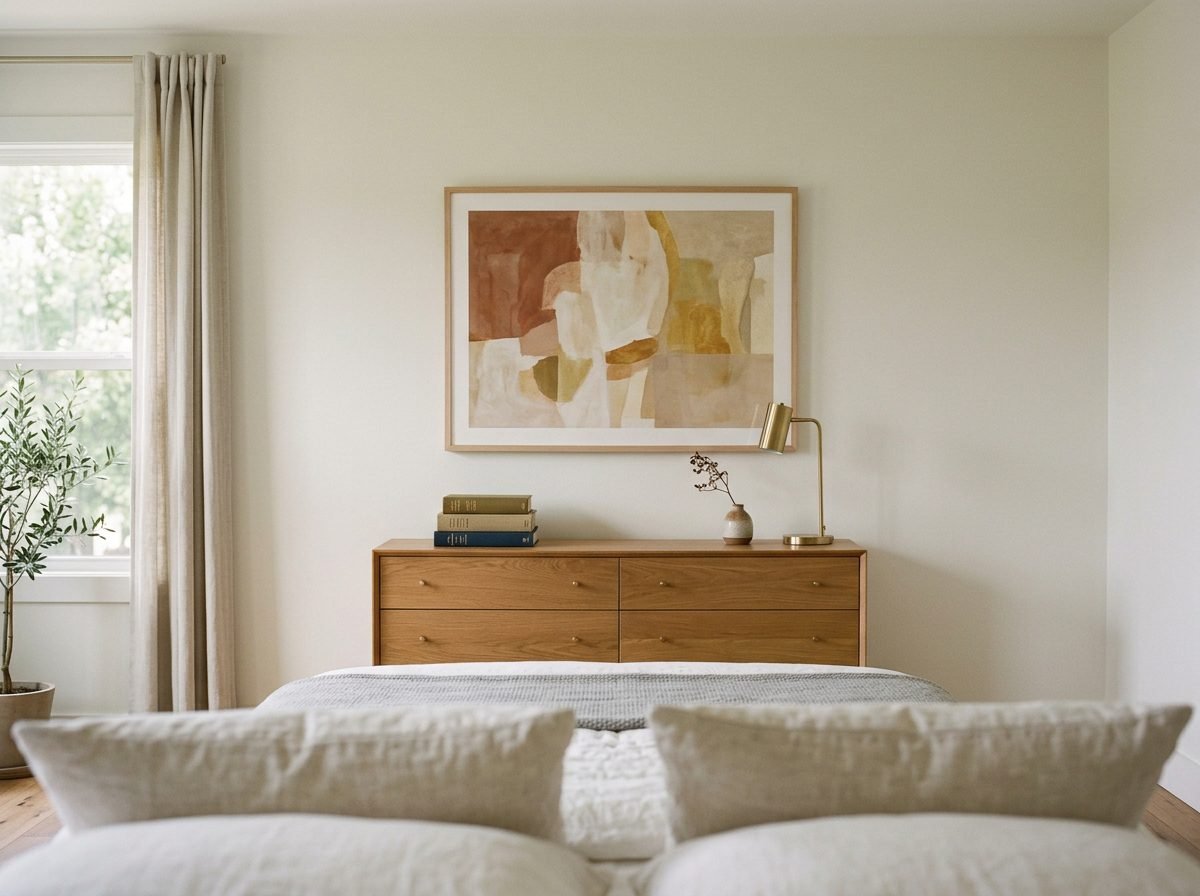
- Above a dresser, size the art to about two thirds of the dresser width and sit the bottom edge 6 to 10 inches above the surface
- For bedside wall lights meant for reading, put the bottom of the shade near shoulder height when sitting up, usually somewhere between 40 and 48 inches from the floor
One more that gets missed: the short wall between the bed and the corner. It rarely fits art. A single hook, a small shelf or one narrow mirror stops it reading as leftover space.
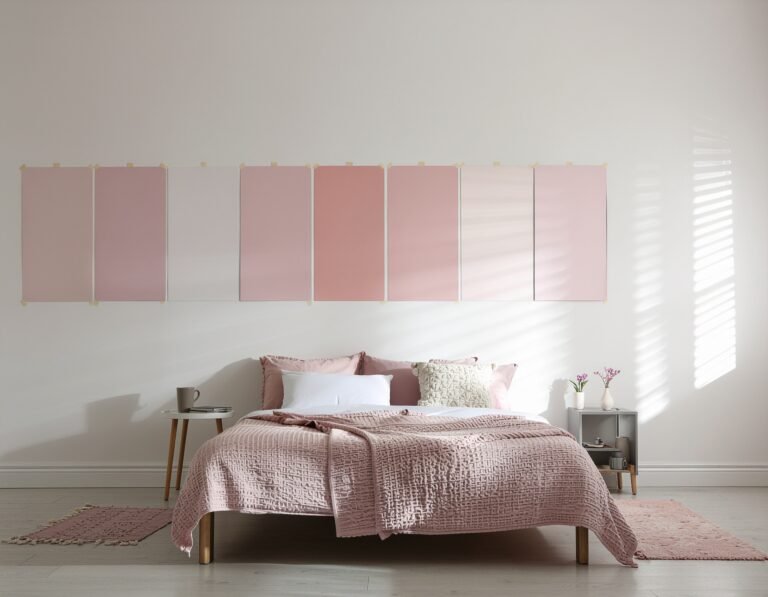
Cut newspaper or wrapping paper to the size of each piece and tape it up for a day before drilling. It costs nothing and catches most proportion mistakes.
The Walls Nobody Plans For
Two views are covered by now. The leftover surfaces are where a bedroom either feels finished or feels half done.
Behind the door. Often the only completely blank wall in the room. Hooks, a slim shelf or a mirror at standing eye level all work, but nothing can stick out more than a couple of inches without meeting the door.
Beside a window. Narrow strips suit vertical formats or a single wall light far better than a horizontal piece squeezed in sideways.
Above the dresser. The second most useful display surface in the room, and the easiest one to change. Leaning art here needs no fixings at all.
Sloped ceilings. In a loft or attic bedroom, hang lower than usual and follow the slope line rather than fighting it. One piece reads better than a group on an angled wall.
Not every wall needs something. In a room whose main job is sleep, empty wall is a feature rather than an unfinished task.
What Should Never Hang Above a Bed
This is the one part of bedroom wall decor that is not a matter of taste.
The Centers for Disease Control and Prevention advises moving heavy mirrors and pictures from above beds and seating. The alternative it gives is securing them with wire through eye screws bolted into wall studs.
That applies well beyond earthquake country. A heavy frame over a pillow is held up by whatever fixing went into the wall that day. Drywall anchors loosen quietly over years.
A few sensible habits:
- Keep heavy mirrors and large glass-fronted frames off the wall directly above the pillows
- Fix anything substantial into studs, using two points rather than one
- Use closed hooks, which cannot let a wire jump off, rather than open ones
- Skip shelves above a bed entirely, because everything on a shelf is something that can fall
- Do not run a cord across the wall above the pillows
The good news is that the look survives the rules. Fabric hangings, unframed canvas, acrylic glazing and a painted headboard wall all give the same effect. Nothing heavy ends up overhead.
If You Only Change One Wall
Make it the one facing the bed.
Clear whatever has accumulated there. Hang a single calm piece at a height that works from lying down, and live with it for a week. Most people find that one change does more than the four smaller purchases they were planning.
The headboard wall can wait. It will look perfectly fine with nothing on it, because the bed was always doing that job anyway.