7 Garden Terrace Mistakes That Waste Your Outdoor Space
Most unused terraces are not too small. They are badly arranged. A table blocks the door swing. The only chair faces a blank wall. The terrace turns into somewhere you walk past on the way to hang laundry.
The fixes are rarely expensive. They are dimensional. Twelve inches of clearance in the right place decides whether a chair is comfortable or in the way.
What follows is seven errors that turn a workable terrace into storage. Each one comes with the measurement, material or rule that prevents it. Prices below are ballpark figures and shift by region and season, so read every number as a range.
Furniture Bought Before the Floor Was Measured
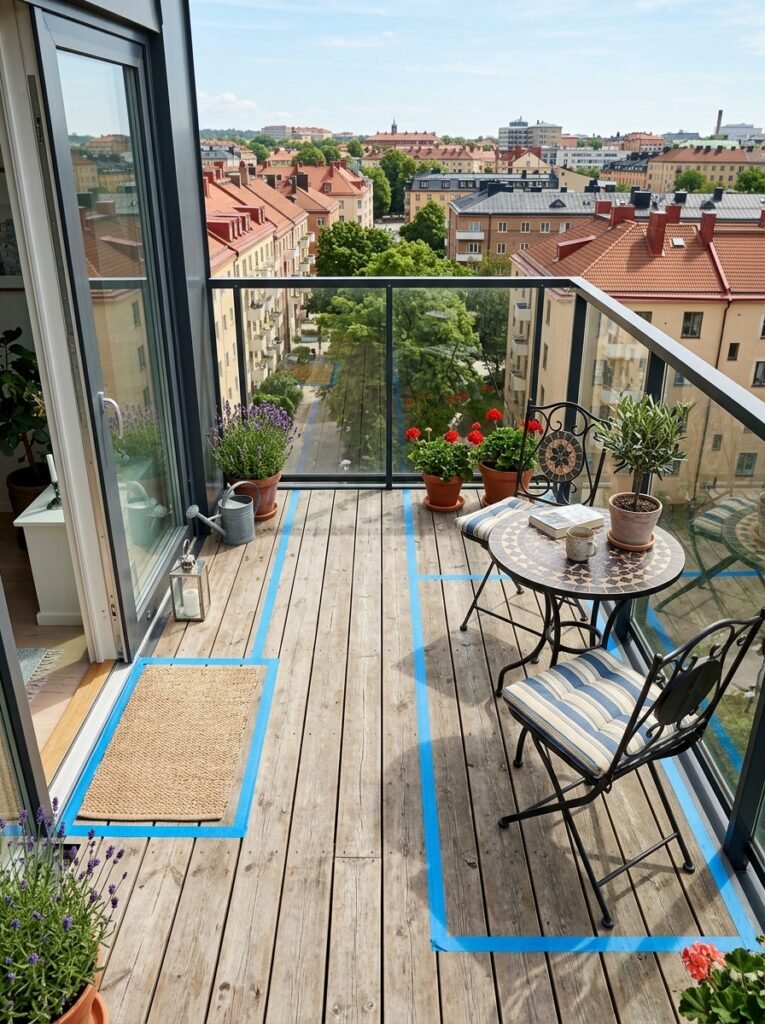
Measure the usable floor, not the total floor. Subtract the door swing. Subtract the strip in front of any drain or hose bib. What remains is what you are furnishing.
Three numbers govern the layout. Leave 30 to 36 inches (76 to 91 cm) for the main walking path. Allow another 30 to 36 inches behind each dining chair so it can pull back. Give every diner 24 inches (61 cm) of table edge.
Apply those numbers to a 7 by 12 foot (2.1 by 3.7 m) terrace and a six seat dining set stops fitting. The end chairs cannot pull back properly. People quietly stop using them, and a set bought to seat six ends up seating four.
A round 30 inch (76 cm) bistro table handles two people and leaves floor for a lounge chair. That second zone is what makes a terrace feel like a room rather than a corridor.
Tape the footprint on the floor before ordering anything. Painter’s tape costs a few dollars and exposes a bad plan in ten minutes. Walk the route from door to railing with the tape down, carrying a full mug.
Ballpark: folding bistro sets run $80 to $250, full dining sets $400 to $1,500. Renters and tight terraces do better with folding or stacking pieces that clear the floor when the space is needed for something else.
No Shade at 2 p.m., No Warmth at 8 p.m.
Sit outside for one full day before buying anything. Note the hours the seating area sits in direct sun. Most people find the terrace is unusable from roughly 1 p.m. to 5 p.m. in summer, which is exactly when they pictured using it.
A center pole umbrella shades one fixed spot. The shadow slides off the table as the sun moves. A cantilever umbrella tilts and rotates, so the canopy follows the sun without anyone moving the furniture.
Base weight is what people underestimate. A 10 foot (3 m) cantilever needs 150 to 220 pounds (68 to 100 kg) of base, usually four weight plates. A center pole umbrella running through a table needs 30 to 50 pounds. Standing free, it needs 70 pounds or more. Close any umbrella once wind passes roughly 15 to 20 mph (24 to 32 km/h).
Shade sails cost less, from $40 to $150. They need a pitch of at least 20 degrees so rain runs off instead of pooling. Anchor points have to reach real structure, never railing infill.
Evening use is a separate question. One state code bulletin sets out the common rule plainly. Open flame cooking devices are barred from combustible balconies. The same limit applies within 10 feet (3 m) of combustible construction. Many buildings extend that ban to fire bowls and propane heaters of any kind. A UL listed electric infrared heater is usually the workable substitute.
The Weight Nobody Adds Up
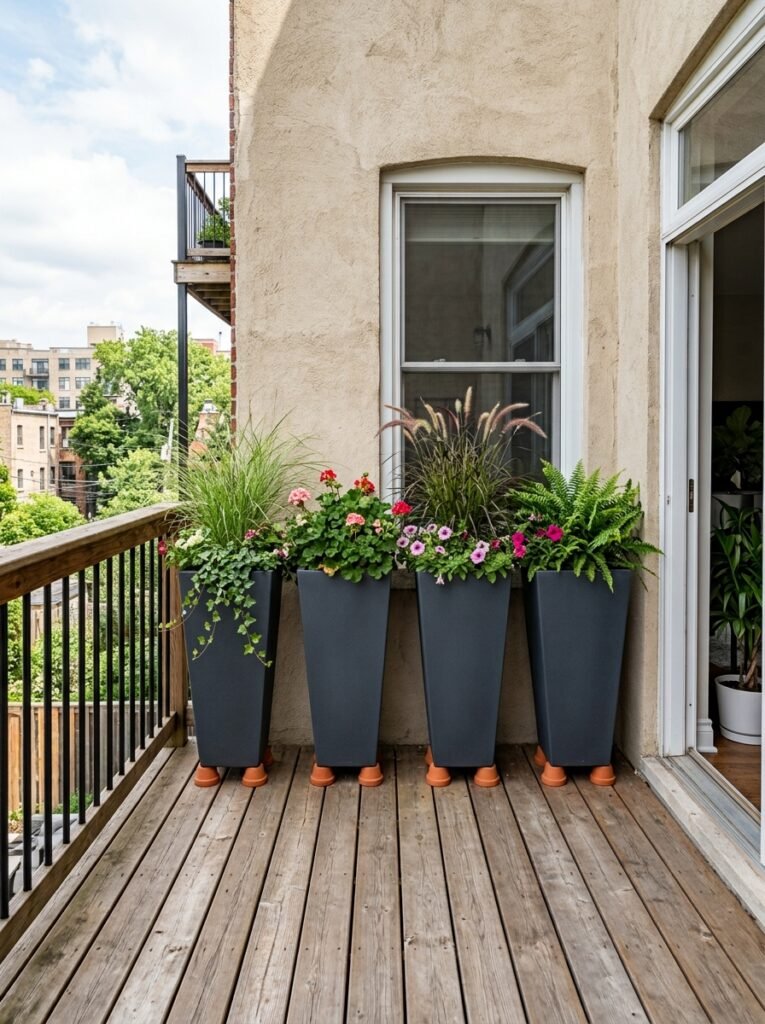
Soil is heavy, and wet soil is far heavier. Saturated potting mix runs 40 to 60 pounds per cubic foot (640 to 960 kg per cubic meter). Wet garden topsoil can pass 90 pounds per cubic foot, which is why it has no place in terrace containers.
A 24 inch (61 cm) planter holds roughly 3 cubic feet of mix. After heavy rain, that is 120 to 180 pounds of soil alone. Add a glazed ceramic or concrete pot and the total clears 250 pounds. Line eight of those along the railing and the outer edge is carrying over half a ton.
Many residential decks and balconies are framed for a 40 pound per square foot live load. Count the structure’s own weight and the total sits nearer 50. Roof terraces vary far more than that. Treat your own figure as unknown until building management or a structural engineer confirms it.
Three changes cut the risk. Use fiberglass or resin planters, at $60 to $250, rather than concrete at $150 to $600. Choose a peat or coir mix with perlite instead of bagged garden soil. Keep the heaviest containers near the building wall or over a beam. Avoid mid span and the outer railing.
Depth drives weight more than width does. Annuals root happily in 8 to 10 inches (20 to 25 cm). Grasses and perennials want 12 to 16 inches. Only shrubs and small trees need 18 inches or more.
Solid Privacy Screens Make Wind Worse
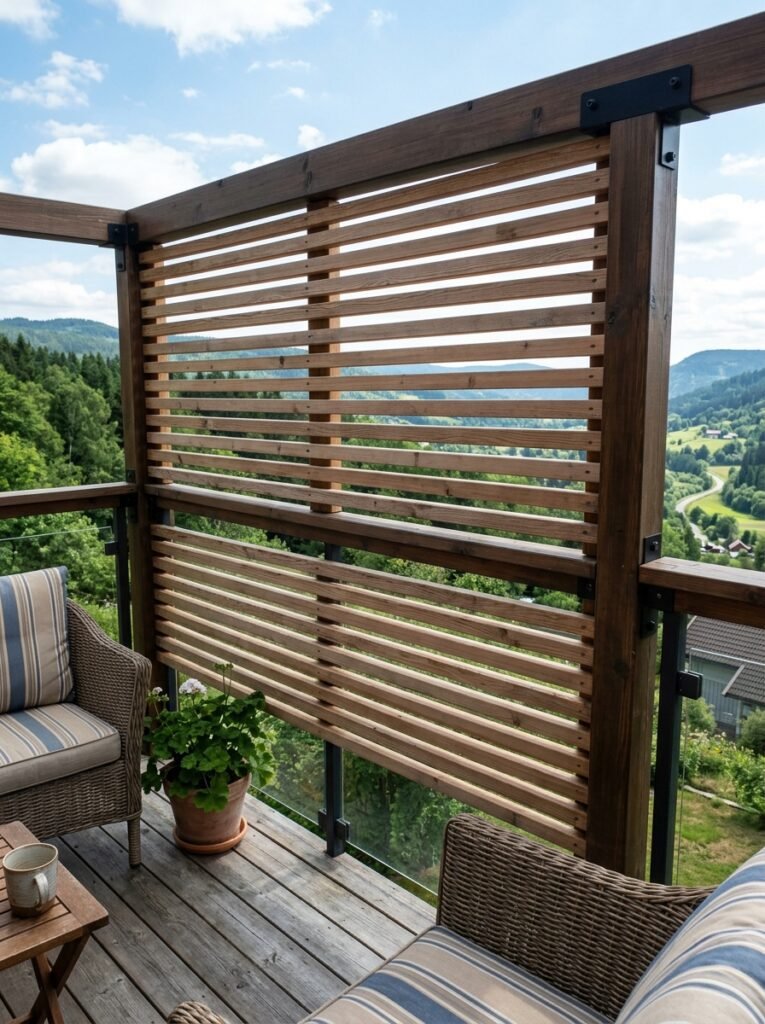
A solid panel does not stop wind. It catches wind. Air piles up against the windward face and spills over the top. It then drops into a turbulent pocket, right where the seating sits. The panel also loads whatever railing it is tied to.
Screens that let air through perform better. Aim for something 40 to 60 percent open: slatted cedar, woven willow, reed roll, or heavy polyester mesh. A permeable barrier slows wind across a stretch roughly ten times its own height, which covers most terraces end to end.
Attachment is the usual point of failure. Plastic zip ties turn brittle after one season and snap in the first real gust. Use stainless steel hardware, marine grade cable ties, or railing brackets rated for the panel size. Check every fixing each spring.
Ballpark costs:
- Reed or willow roll, $25 to $60 for a 13 foot (4 m) length
- Slatted cedar panel, $60 to $150 each
- Polyester mesh windbreak fabric, $30 to $80
Renters have a clean route here. Grommeted mesh and reed rolls attach to the railing with cable ties and leave no holes behind. Read the lease first. Plenty of buildings restrict anything visible above the railing line, and some ban screening outright on street facing elevations.
Height is a judgment call. A screen tall enough to block a neighbor’s sightline usually blocks your own light and view as well. Screening one side and leaving the rest open is often the better trade.
Where Does the Water Actually Go?
Terrace floors are laid with a slope, usually around 1/4 inch per foot (2 percent). That fall runs away from the building toward a drain or scupper. Anything that flattens that slope creates a puddle. Thick mortar beds and solid rubber mats both manage it.
Blocked drains cause the expensive version of this problem. Potting soil washes out of containers, mixes with leaves, and packs the outlet. Water backs up, sits against the waterproof membrane, and eventually finds a seam. Clear the drain in spring and again in late fall.
Saucers are the quiet culprit under planters. A full saucer holds water against tile or decking for days. Pot feet raise the container half an inch to an inch and cost $8 to $20 a set. On a wood deck, that gap is the difference between a stain and rot.
Rug fiber matters more outdoors than indoors. Polypropylene sheds water and dries fast, at $40 to $150 for a 5 by 8 foot rug. Jute and sisal hold water and rot, whatever the label claims about outdoor use. Lift any rug after heavy rain, or expect a permanent outline on the floor beneath it.
Interlocking deck tiles are a strong renter option at $2 to $6 per square foot. Pick a version with drainage channels molded into the underside. Solid matting traps water and will discolor the surface it covers.
One Bulb Is Not a Lighting Plan
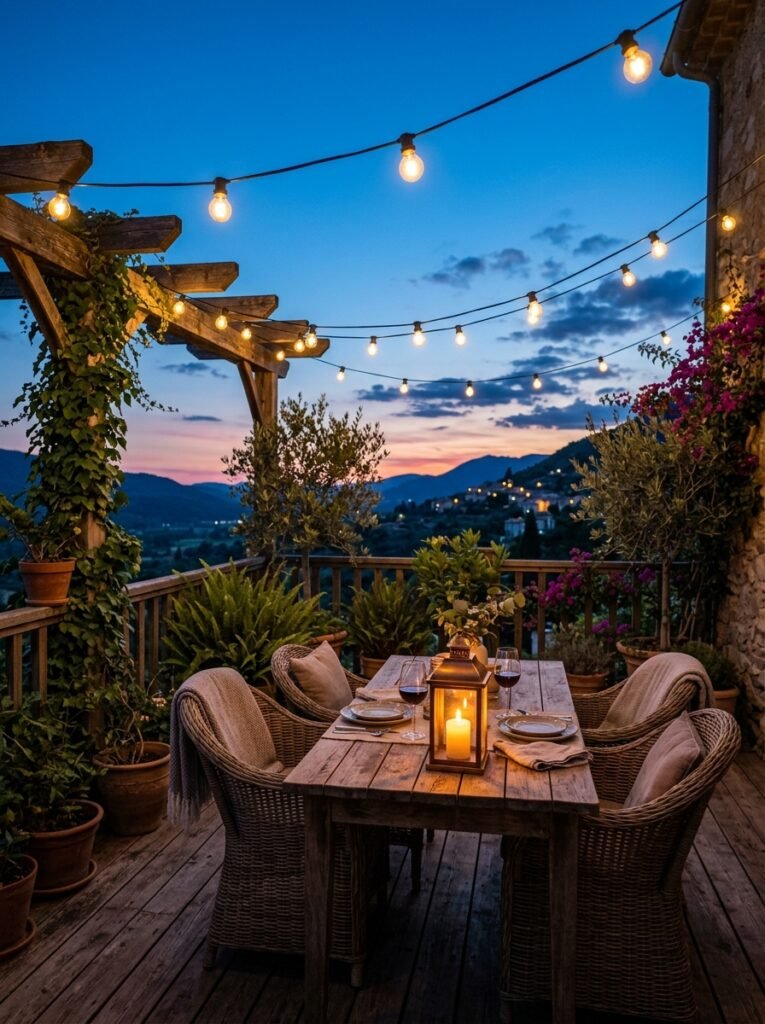
The existing fixture is almost always a wall light beside the door, aimed outward, running at 3,000K or cooler. It lights the doorway and glares at anyone sitting down. Everything past six feet stays black.
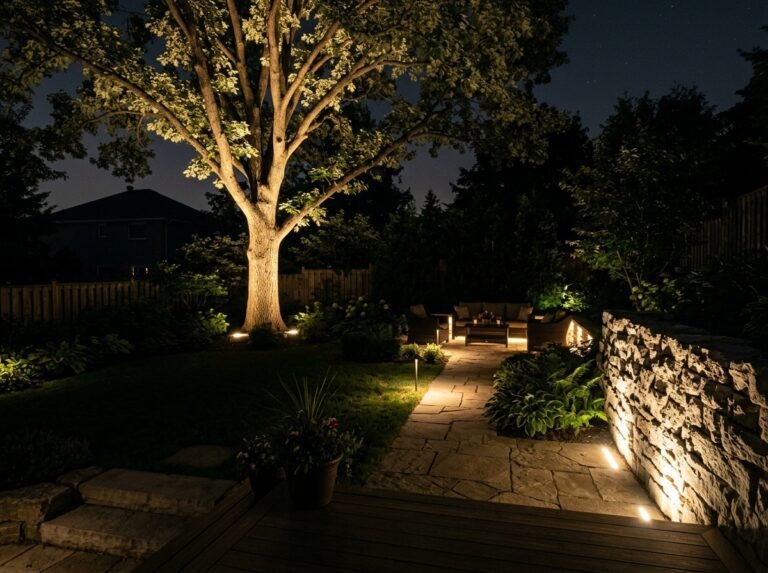
Build three layers instead. Overhead comes from string lights or a shade mounted line at 8 to 9 feet (2.4 to 2.7 m). Seat height comes from lanterns and table lamps at 24 to 30 inches. Ground level comes from small uplights tucked behind planters.
Warm color temperature carries the mood. Stay between 2,200K and 2,700K. Anything above 3,000K reads clinical outdoors and undoes the rest of the scheme.
Weather ratings are not optional. Use IP44 as the minimum under cover, and IP65 for anything fully exposed to rain. An indoor rated fixture on an open terrace fails within a season.
Costs run wide. Commercial grade string lights are $30 to $90 for a 48 foot (15 m) run. A 12 volt low voltage kit with transformer sits at $80 to $200 and needs a protected outdoor outlet. Solar path lights start near $15 but dim badly in winter and on shaded terraces. Our outdoor lighting ideas post covers the layering in more detail.
Rechargeable USB table lamps at $25 to $70 are the renter answer. No wiring, no drilling, and they move with the furniture. Keep output modest, around 40 to 100 lumens at seat level, because eyes adapt to very little light outdoors.
Garden Plants Put in Terrace Conditions
A terrace is a harsher site than a garden bed. Wind strips moisture from leaves. Walls and paving reflect heat back at the pots. Roots sit in a small volume of mix that bakes in summer and freezes through in winter.
Container roots have no surrounding soil mass to insulate them, so plants overwinter as though they live somewhere colder. Buy material rated one to two USDA zones hardier than your own. A zone 7 terrace calls for zone 5 plants in pots.
Wind tolerance narrows the list again. Ornamental grasses, rosemary, lavender, juniper, dwarf pine, boxwood and sedum all cope well. Large soft leaves do not. Hostas, hydrangeas and banana plants shred within weeks on an exposed terrace.
Water is the other common failure. A sunny terrace container in July can need water every single day. A drip kit with a battery timer, $40 to $120, covers both the heatwave and the two week vacation.
Fewer, larger containers beat a crowd of small ones. A 20 inch pot holds enough mix to stay damp overnight. A 10 inch pot dries out by lunchtime and cooks the roots inside it. Self watering containers with a reservoir, $25 to $80, buy another day or two between waterings. Our container gardening ideas guide goes further on pot sizing.
Buy across the seasons, not only in May. Garden centers push peak flowering stock in spring, which is why so many terraces look finished in June and bare by August.
Where to Start
Order matters more than budget on a terrace. Tape the layout on the floor before buying a single piece of furniture. Everything downstream depends on that footprint being right, and painter’s tape costs almost nothing.
Confirm what the structure can carry next. This matters most where the plan involves large planters, stone pavers or a water feature on a roof terrace. Building management can usually point you to the original drawings.
Shade comes third, because it decides how many hours the space is usable at all. Wind screening, drainage, lighting and planting follow in that order. Each one is cheaper and simpler to get right once the layout is settled.
If only one item fits this season’s budget, make it shade. A terrace that bakes from one until five is a terrace nobody sits on, whatever the furniture cost. A clamp on railing umbrella at $40 to $100 changes that on the afternoon it arrives.
One last note on the figures above. Treat them as starting points, then measure your own space and check your own building’s rules before ordering.