Very Small Balcony Ideas That Work Under Four Feet Deep
Most balcony advice is written for a balcony about six feet deep. At that size there is room for a folding table, two chairs, a rug and a strip to walk down.
Under four feet, almost none of it survives contact with the actual floor. The chair that fits leaves nowhere to stand. The table blocks the door. Buying smaller versions of the same things does not fix it. The problem is not the size of the furniture. A very small balcony can only do one thing properly, and the standard list assumes it can do five.
What Changes Under Four Feet
Depth is the constraint, not floor area. A balcony 3 feet deep and 12 feet long has a respectable square footage and still fits almost nothing. Nothing can sit opposite anything else.
Three things shift once the depth drops:
- Seating stops being simple. A normal outdoor lounge chair is 30 to 34 inches deep. Add knees and there is nothing left to walk past. Slim balcony chairs at 20 to 24 inches are a different product, not the same one in a smaller photo.
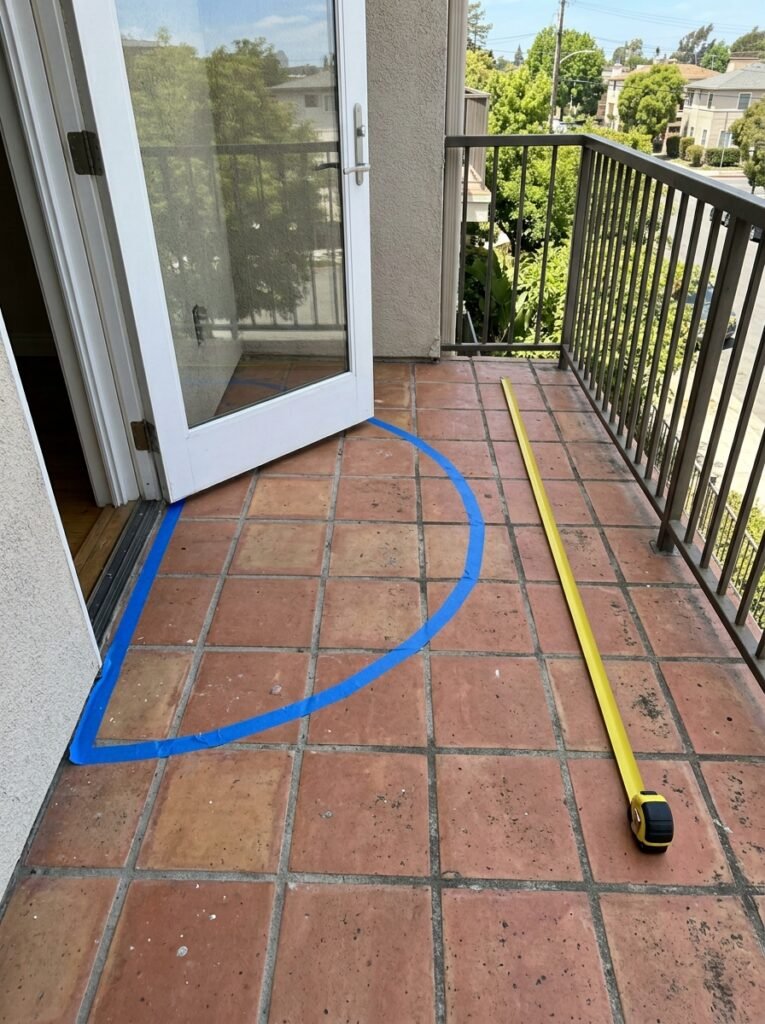
- The door takes a share of the floor. A door that opens outward sweeps an arc that has to stay permanently empty. Sliding doors hand that whole area back, which is why two balconies of identical size can be completely different spaces.
- Everything is close to the eye. At this depth nothing is ever seen from across the room. Finishes, chipped paint and plastic pots all read at arm’s length.
Chalk or tape the door arc onto the floor before deciding anything. Treat that arc as a piece of furniture that is already there, because functionally it is.
Leave a clear strip to move through as well. Around 20 inches lets someone squeeze past. Closer to 24 is comfortable.
Give the Balcony One Job
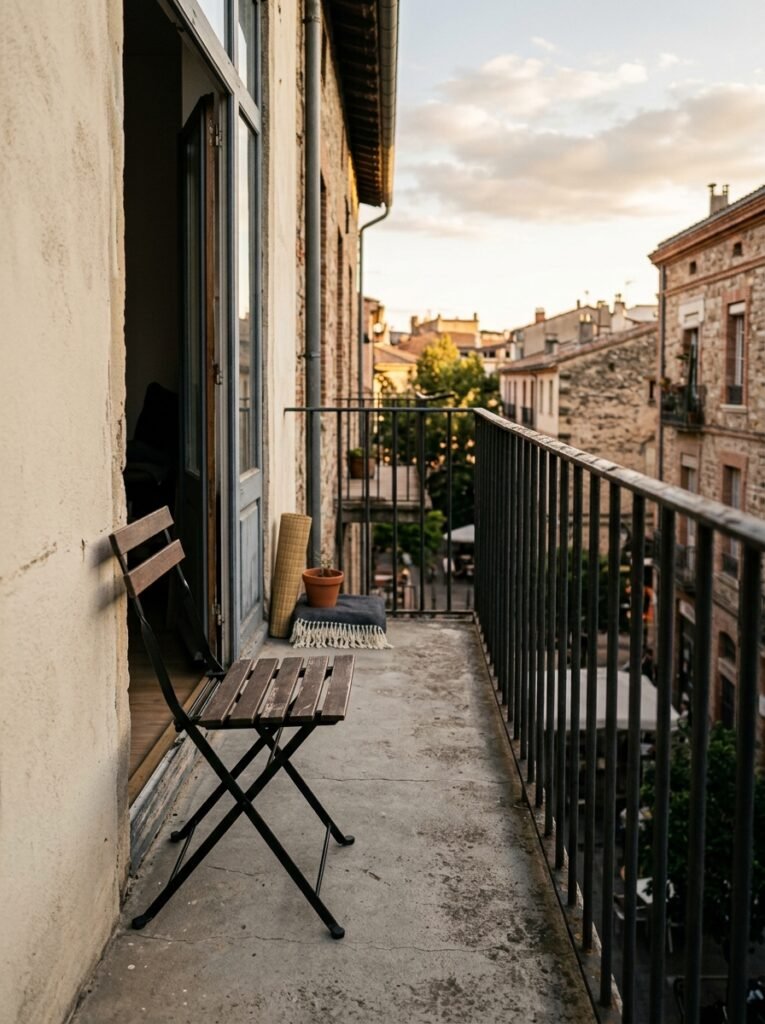
The common failure is fitting a miniature version of a full balcony into a space that holds one thing. A seat, a table, plants, storage and a drying rack all appear. The result is a corridor of obstacles nobody uses.
Two questions settle it quickly. What time of day will this get used, and by how many people? For most very small balconies the honest answer is once a day, by one person.
That answer is not a disappointment. It is the design brief. Once the job is chosen, everything that does not serve it goes indoors or goes away. The space stops feeling cramped almost immediately.
The four setups below cover the jobs a very small balcony can actually hold.
Setup One: The Rail Bar
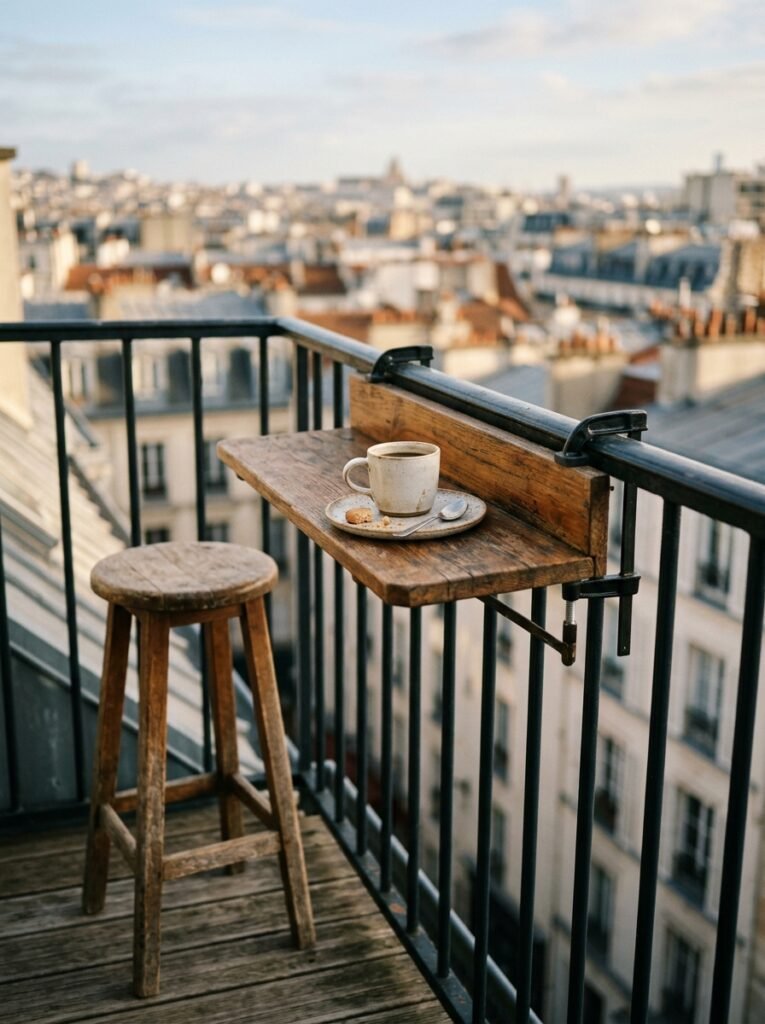
For anything under about 3 feet 6 inches deep, standing works better than sitting.
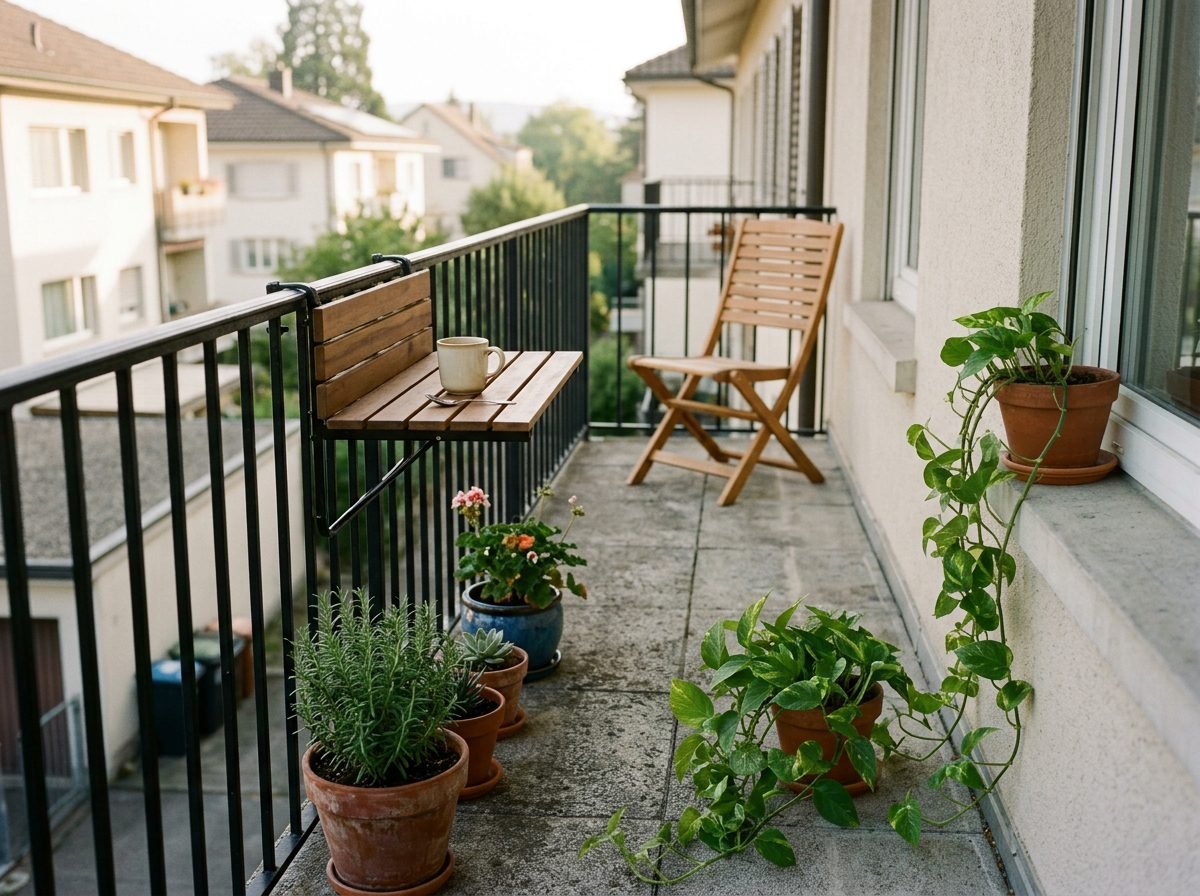
A fold-down shelf or a clamp-on rail table gives a surface without using floor. Something 8 to 12 inches deep takes a mug, a plate and a phone. That is the entire requirement for morning coffee or ten minutes after work.
Rail tables clamp onto the top rail, so the rail profile decides what fits. Flat top rails take almost anything. Round tube rails need a clamp made for the shape. Glass and frameless panels usually need something else entirely. Measure the rail before ordering, not the balcony.
Rail tops normally sit 36 to 42 inches above the floor, which is bar height. A 28 to 30 inch stool that lives indoors and comes out when needed suits it better than anything permanent.
The shelf folds flat when it is not in use. The floor stays clear for the door, the drying rack, or simply standing.
One thing to check before buying: a rail shelf lives outdoors in all weather. Powder coated steel or a properly finished hardwood survives it. Bare pine swells, greys and starts lifting at the joints inside a year.
What it gives up: meals, and having anyone over.
Setup Two: One Good Chair
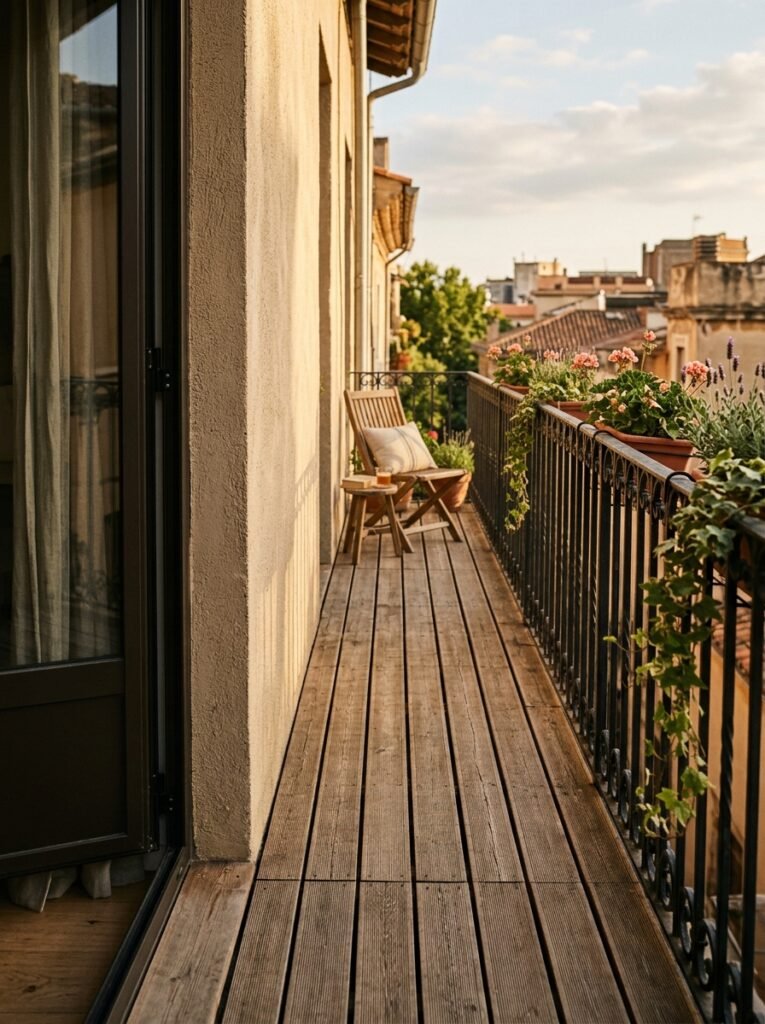
If the depth reaches roughly 3 feet 6 inches to 4 feet, a single chair becomes possible.
One chair, not two. A second chair on a balcony this size is furniture for a visitor who comes twice a year. It costs the space every other day.
What to look for:
- Seat depth under 24 inches, with a fairly upright back
- A folding or stacking frame, so the balcony can be cleared in seconds
- Armless or slim armed, since arms add width in a place with none to spare
- Something light enough to lift with one hand
Put the chair at one end, clear of the door arc. Angle it along the length of the balcony rather than square to the railing. Facing along the space gives the eye somewhere to travel. Facing straight out puts a railing three feet from the nose.
A small stool beside it earns its place twice. It is a side table and a step for reaching higher plants.
What it gives up: eating at a table, and any real storage.
Setup Three: All Plants, No Furniture
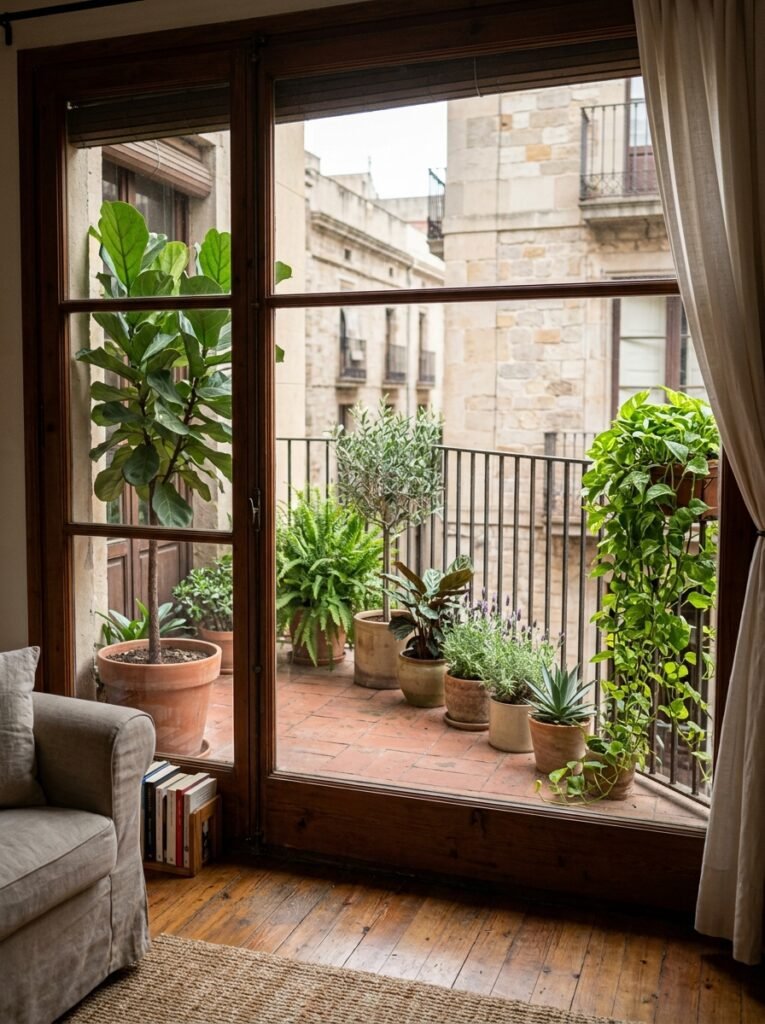
The most underrated option for a very small balcony is deciding not to sit on it.
Some balconies are simply too shallow, too windy, or too overlooked to be pleasant to occupy. Those work far better as something to look at from the room behind the glass. That is where they get seen for most of the year anyway.
Composition on a narrow balcony works along a line rather than in a group. Something tall at each end. A mid height run along the middle, and something trailing at one corner to break the horizontal. Keep the centre of the floor clear so watering does not become an obstacle course.
Weight belongs on the floor rather than the railing wherever possible. Floor pots are stable in wind and they are not the ones that end up on the sidewalk.
Be honest about the conditions before buying. A shallow balcony on an upper floor is windier and drier than ground level. Pots on a narrow ledge dry out faster than anything planted in a bed.
Choose at least one evergreen shape. A window view of bare sticks from November to March undoes the whole point of the setup.
What it gives up: using the balcony as a place to be.
Setup Four: The Honest Utility Balcony
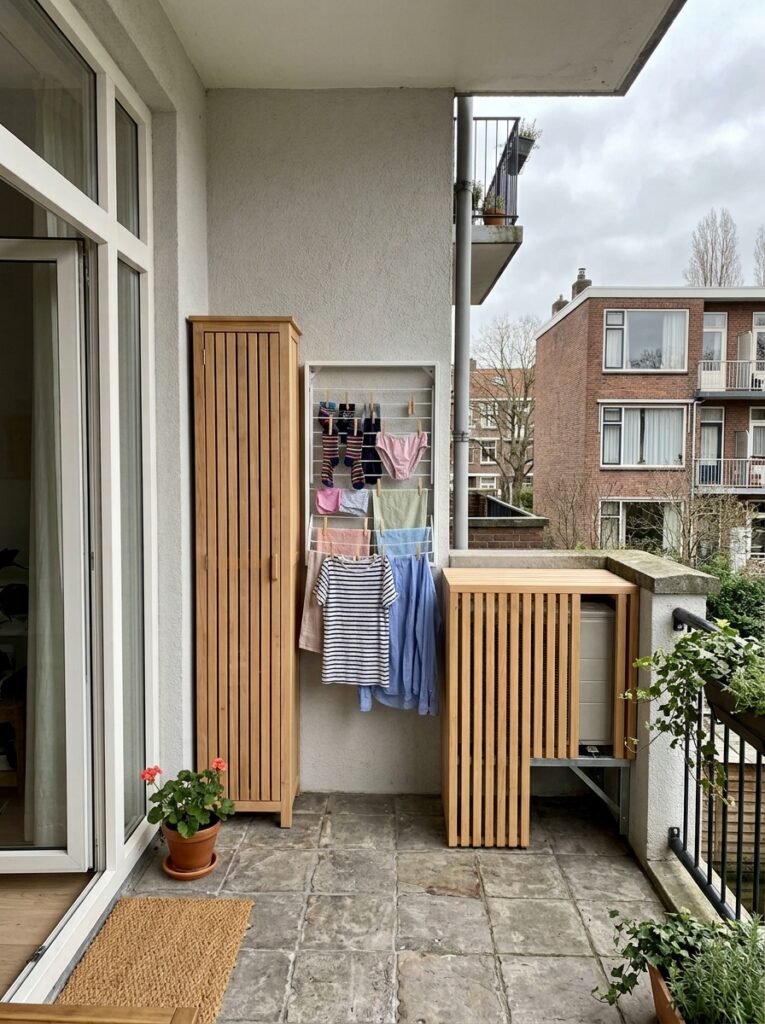
Plenty of very small balconies already hold a condenser unit, a boiler flue, bins or a bike. Some hold the only place in the apartment where laundry can dry. Styling around all of that while pretending it is not there is why so many of them look unfinished.
Drying laundry is a genuinely good use of a shallow balcony. A fold-flat wall rack or a rail-hung rack does the job and then disappears, which no piece of furniture manages.
For the mechanical equipment, leave the airflow alone. Screen the sides if the look bothers you, but keep the top open. Check the manual for the clearances the manufacturer asks for. The ENERGY STAR maintenance checklist covers what the rest of the system needs through the year.
Two habits make a working balcony look deliberate rather than neglected. Use one material for the storage and one for any screening, instead of whatever was cheapest each time. And keep some floor visible. A fully covered floor reads as a storage cupboard, however tidy the contents are.
A slim vertical cabinet against the wall beats a storage bench at this depth. Benches need floor. Cabinets only need wall.
Six Quick Answers
Can two people use a very small balcony at once? Standing, yes. Seated, rarely, unless both chairs face the same direction in a line. Two chairs facing each other need roughly 5 feet of depth.
What is the smallest depth that is genuinely usable? Around 3 feet supports standing, plants and drying. Sitting comfortably starts near 3 feet 6 inches. Below about 2 feet 6 inches, treat it as a window box with a door.
Should the floor be covered? Interlocking deck tiles usually work better than a rug here. At this depth most of a rug sits under feet and furniture. It also stays damp in a spot that rarely gets sun.
Where does everything live in winter? Indoors, which is the argument for folding and stacking pieces. Anything that has to stay out should be something that survives being rained on for four months without attention.
What about privacy? Screening the full height of a very small balcony usually costs more light than it gains in privacy. Screening only up to seat height, on the one side that overlooks, is generally the better trade.
Is it worth doing at all if it is this small? A balcony used every morning beats a bigger one used twice a summer. Size decides what fits, not whether it is worth the effort.
Before You Hang Anything Over the Edge
Railings are designed to stop a person falling. They are not designed as shelving. On a small balcony the temptation to treat them that way is strong.
A few rules keep this sensible:
- Hang planters and hooks on the inside face, never the outside. Anything on the outside can fall onto a sidewalk, and it is a long way down
- Check the lease and the building rules before fixing anything to the railing at all. Many buildings prohibit items on the outer face outright
- Remember that a solid screen catches wind and passes that load straight into the railing
- Keep heavy pots on the floor and near the building wall rather than at the outer edge
- Retie or recheck anything hung on the railing at the start of each season, since ties go brittle over a winter
The weight and wind side of this deserves more room than one section allows. There is a fuller treatment of loads, screens and drainage in this piece on terraces that end up unused.
Is One Chair Really Enough?
For a balcony this size, yes, provided it gets sat in.
The measure of a balcony is how many times a week someone steps onto it, not how much it holds. One chair, one shelf and three pots, used daily with a coffee, is a successful balcony. A bistro set that has to be shuffled around to open the door is not. It photographs better and gets used less.
Pick the one job and buy for that. The rest of the list belongs to somebody with six feet of depth.