Affordable Rooftop Ideas That Will Not Cost You the Deposit
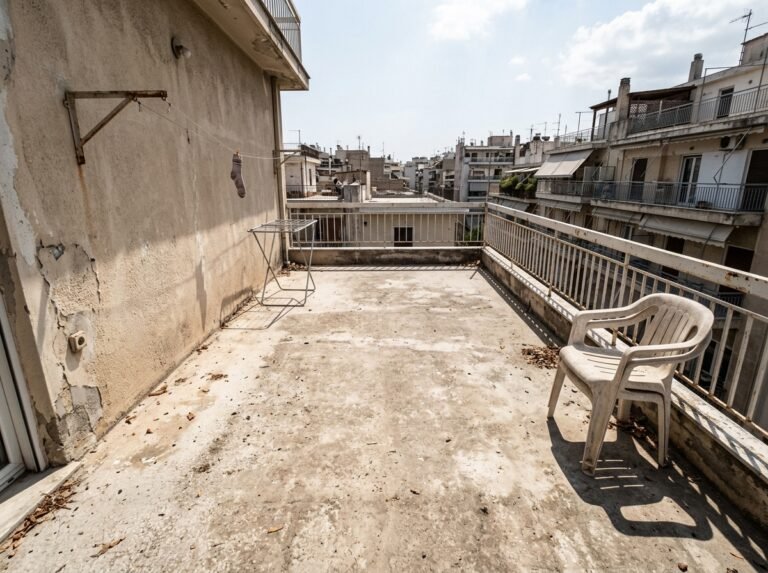
A rooftop is the only outdoor space where decorating badly can cost more than the furniture did. The surface underfoot is a waterproof membrane. The structure below it may never have been rated for people. Both of them belong to somebody else.
None of that means spending more. It means spending in a different order. The cheap protective layer goes down before the nice things sit on top of it.
What follows is an affordable rooftop setup built around what the roof can physically take. It runs from the first email to the landlord through to the weekend you carry it all back down. Prices are ballpark and move with region and season, so read every figure as a range.
Start With What the Roof Is Allowed to Carry
Three questions decide whether this project is worth starting. May you use the roof. May you place freestanding items on it. What has to come off before you hand the keys back. Put all three in an email, because an email is a record.
Load capacity is the answer most landlords do not have to hand. Older flat roofs were framed for maintenance access alone. That can mean 20 to 30 pounds per square foot. Roofs designed for people are built to much higher figures, and those figures differ by city. Ask the managing agent to check the drawings.
Collect the rest of the picture while you are asking. Where do the drains sit. Is there a parapet or a guard, and how high does it stand. A roof intended for occupancy usually has a guard around 42 inches (107 cm). A low parapet means the space was never set up for people, and nothing climbable should go anywhere near it.
Photograph everything before the first delivery arrives. Corners, drains, membrane seams, existing damage. That set of images costs nothing and settles every deposit argument later.
None of this is decorating. All of it decides how much decorating you can afford to risk.
Everything the Membrane Cannot Forgive
The surface underfoot is a waterproof layer, usually TPO, EPDM or modified bitumen. It is thinner than it looks, and it is the most expensive thing on the roof to damage.
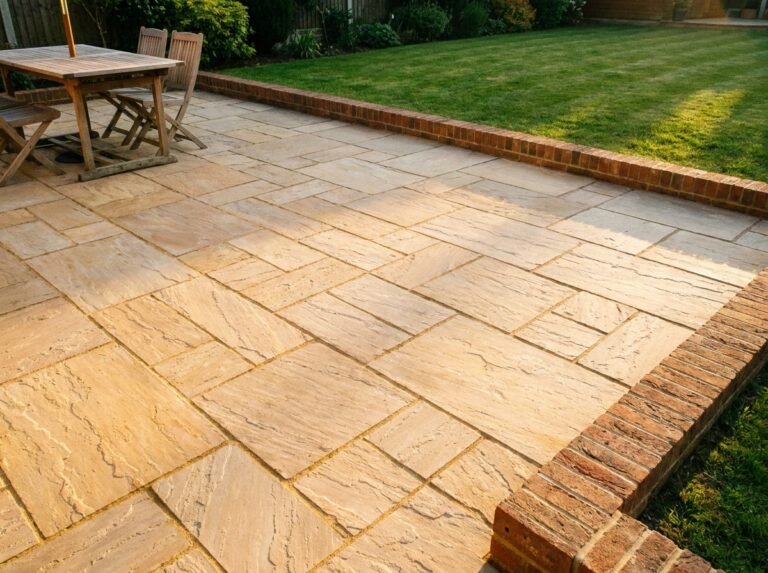
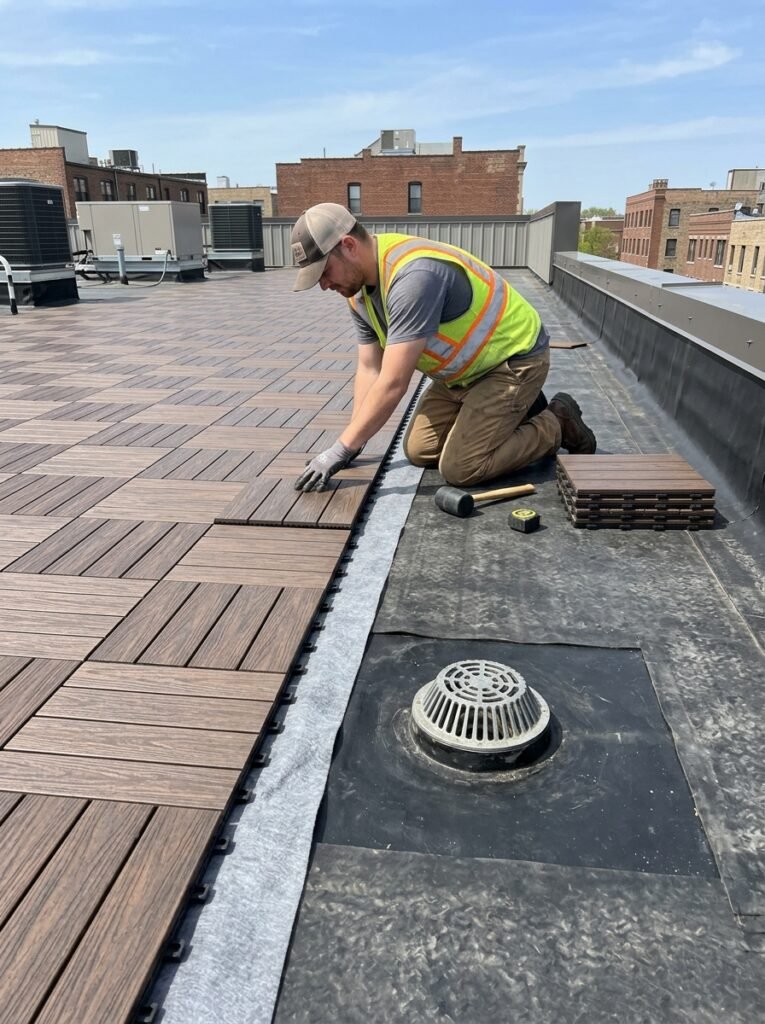
Interlocking deck tiles are the standard fix at $2 to $6 per square foot. A 100 square foot area lands between $200 and $600. Most are 12 by 12 inches (30 by 30 cm) on plastic bases, at 2 to 4 pounds per square foot.
Lay a protection layer first. Geotextile fabric or thin rubber matting costs $0.30 to $1 per square foot. Choose tiles with wide flat feet rather than narrow spikes.
Two placement rules matter more than which tile you buy. Leave at least 12 inches (30 cm) clear around every drain. Never cover a seam you cannot lift and inspect.
Grit is what marks a membrane, not the tiles themselves. Lift the whole floor once a year and sweep underneath it.
Saucers under planters hold water against the surface for days. Pot feet raise a container half an inch to an inch and cost $8 to $20 a set.
A large polypropylene rug does similar visual work for $80 to $250 at 8 by 10 feet. Skip jute and sisal, which rot outdoors regardless of what the label claims.
Furniture That Fits the Stairwell
Measure the route before you measure the roof. Door widths, stair turns, landing depth, and the roof hatch if there is one. Hatches are frequently around 30 by 36 inches (76 by 91 cm).
Anything that will not come apart will not come back down. Flat pack, folding and stacking are the only reliable categories for a rental.
Powder coated aluminum is light, which helps on stairs and hurts in wind. Answer that with weight low down or a strap, not with heavier furniture you then cannot carry.
Layout numbers hold up here the same as anywhere. Keep 30 to 36 inches (76 to 91 cm) clear for the walking route. Allow 24 inches (61 cm) of table edge per person.
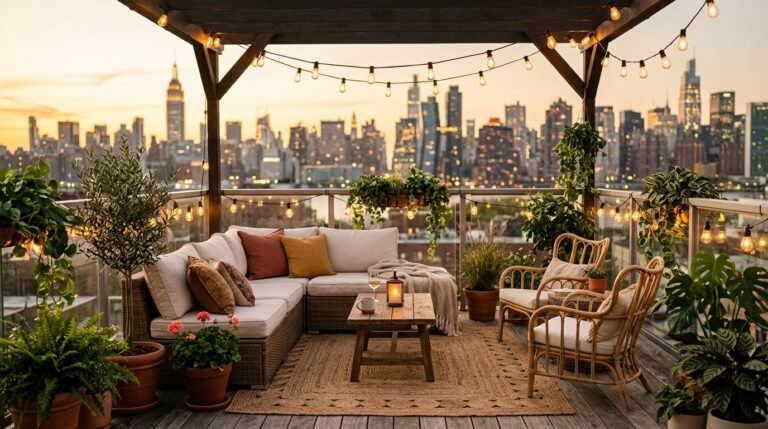
Cost range: folding bistro sets $80 to $250, stacking chairs $40 to $120 each, folding tables $60 to $180. Modular resin wicker seating looks built in but separates into pieces, at $400 to $1,200 for a corner group.
Check packed dimensions against your stairwell before ordering. A welded frame that arrived by freight elevator becomes a moving day problem. Building access has a way of changing between leases.
Where the roof itself is tight, small rooftop decor goes further on scale and proportion.
Shade and Screens Held Down by Weight Alone
Nothing bolts down on a rented roof, so both jobs come back to ballast.
Fill hollow umbrella bases with sand rather than water. Sand runs near 100 pounds per cubic foot against water at 62, so an identical base holds far more mass. A freestanding center pole umbrella wants 70 pounds minimum, and more than that up here. Cantilever models need 150 to 220 pounds (68 to 100 kg).
Close the umbrella whenever you go inside. Close it once wind passes roughly 15 to 20 mph (24 to 32 km/h).
Screens follow the same logic. Freestanding planter trellises sit in their own weighted base, at $60 to $180 each. They block a sightline without touching the parapet. Keep any screen 40 to 60 percent open, because a solid panel catches wind instead of slowing it.
Height needs a ceiling. Anything much above 4 feet (1.2 m) behaves like a sail. Many buildings also restrict what may sit above the parapet line.
Pop up gazebos deserve a plain warning. Even weighted at four legs, the canopy behaves like a kite.
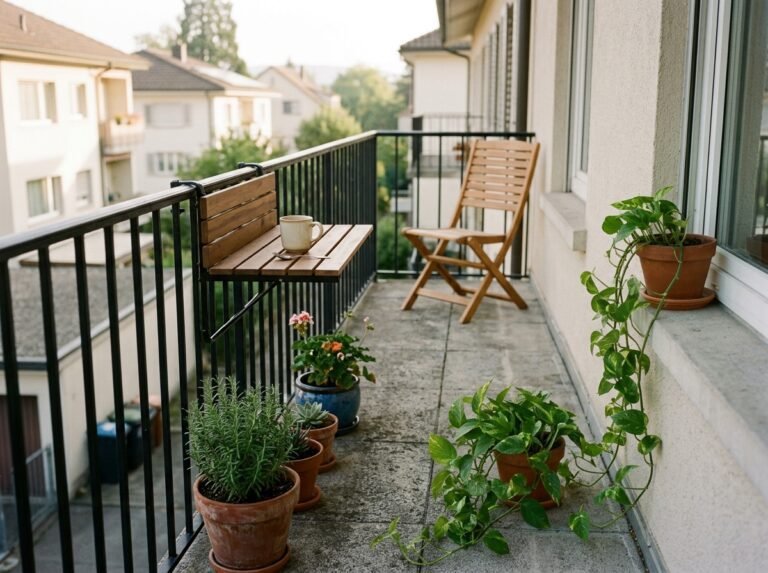
Railing brackets and hook over fittings are a balcony solution rather than a rooftop one. A parapet gives you nothing to hook onto. Those fixings belong with balcony and terrace ideas you can set up without drilling.
Light Where There Is No Outlet
Most rental roofs have no outdoor outlet. Running an extension cord through a window all summer is a trip hazard and usually a lease violation.
Rechargeable USB lanterns and table lamps solve it at $25 to $70 each. Most run 6 to 20 hours per charge and come indoors to recharge, which keeps them out of the weather too.
Solar performs better on a roof than almost anywhere else. The usual reason solar disappoints is shade, and a roof has none. Solar string lights cost $20 to $60 and charge fully most days.
Warmth beats brightness. Stay between 2,200K and 2,700K, and use IP65 rated fittings for anything fully exposed to rain.
String lights need two points to span between. Freestanding pole sets with weighted bases run $60 to $150, and two tall planters can stand in. Do not tie a light run to parapet coping, which sits loose on plenty of older roofs.
One bright cool white floodlight erases the view you moved up here for. Keep output near 40 to 100 lumens at seat level and let the skyline do the rest.
Fabric Is the First Thing to Fail Up Here
Roof UV is unfiltered from sunrise to sunset. No tree, no neighboring wall, no shadow at any hour of the day. Fabric that lasts three years on a shaded patio can look finished by September on a roof.
Printed polyester cushions fade fastest, because the color sits on the surface of the fiber. Solution dyed acrylic holds color for years, because the pigment goes in before the fiber is spun. Expect $60 to $150 for a polyester set against $200 to $500 for acrylic.
The rental calculation differs from a homeowner’s. Cheap cushions are consumables that get thrown out at move out. Good ones travel and still look new at the next place.
Foam deserves the same attention as fabric. Reticulated quick dry foam drains within hours of rain. Standard foam holds water in the core and grows mildew from the inside.
Removable covers split the difference. Buy inexpensive inserts and better covers, then replace only the foam when it gives up.
Everything soft goes into a box when you go inside. On a roof, cushions do not simply get damp. They leave.
Plants, Pots and the Weight Problem
Saturated potting mix weighs 40 to 60 pounds per cubic foot (640 to 960 kg per cubic meter). A 15 gallon fabric grow bag holds roughly 2 cubic feet, so it lands between 80 and 120 pounds after rain.
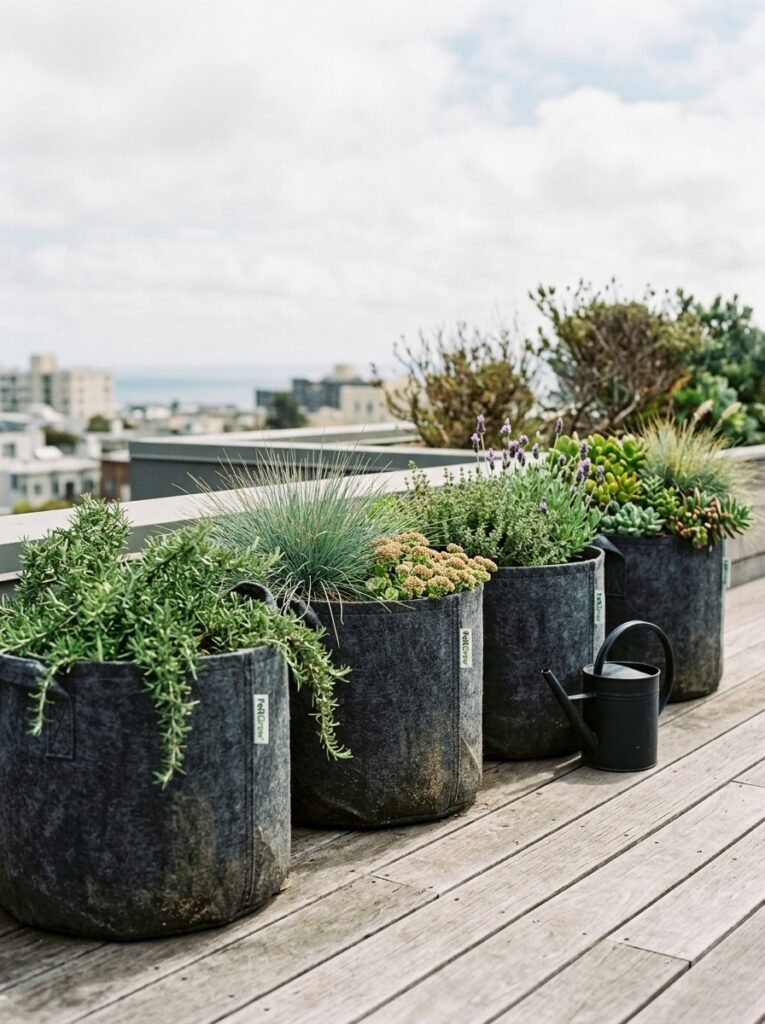
Fabric bags win on every rental measure. They cost $10 to $30 for a multipack, weigh ounces when empty, and fold flat at the end of the lease. Ceramic and concrete do neither, and they crack on stairs.
Spread the load rather than lining pots along one edge. Group containers near walls below instead of mid span, and keep the drains clear.
Root depth sets pot size. Annuals manage in 8 to 10 inches (20 to 25 cm). Grasses and perennials want 12 to 16 inches. Anything woody needs 18 inches or more, which is heavy enough to reconsider.
Container roots freeze harder than ground roots, so buy plants rated one to two USDA zones colder than your own. For wind, stay with ornamental grasses, rosemary, lavender, juniper, thyme and sedum.
Fabric bags dry faster than plastic. A drip kit with a battery timer at $40 to $120 removes the daily watering job and the vacation panic.
Storage Is the Piece Renters Skip
Without somewhere to put cushions, they live indoors. Once they live indoors, going up takes an extra trip, and the roof quietly stops getting used.
A resin deck box between 50 and 120 gallons costs $80 to $250. It seats two people, stores a full set of soft furnishings, and works as ballast because it is heavy once loaded.
Put it on the windward side of the seating so it doubles as a low screen. That one placement decision changes how the space feels on a breezy evening.
Check the lid seal before buying. Budget boxes take on water in flat roof conditions. A box holding an inch of rainwater is a box full of mildew by August.
Raise the base on feet or a pallet strip. Anything sitting flat on a membrane traps moisture underneath it.
Two lidded totes under a folding table do the same job for $40 to $80. Throw a cloth over the top. Skip wicker and rattan, which look excellent for one summer and then fall apart.
Four Purchases That Will Not Move With You
Concrete and heavy glazed planters fail twice over. Too heavy for a roof of unknown rating, too heavy for a stairwell. Fiberglass, resin and fabric give the same look at a fraction of the mass.
Composite decking on sleepers is construction rather than decorating. It needs permission, it needs a permit in many places, and it does not come up cleanly. Interlocking tiles reach most of the same effect and stay reversible.
Anything hardwired or bracket mounted belongs to the building the moment it goes in. Wall lights, mounted planters and fixed pergolas all sit in that group, whatever the seller calls them.
Jute and sisal rugs rot outdoors within a season or two. They photograph beautifully and they are a repeat purchase every single time.
Two smaller traps are worth naming. Standard plastic zip ties go brittle after one winter, so pay the extra dollar for marine grade or stainless. Lightweight parasol bases sold for patios are not rooftop equipment, whatever the product listing suggests.
Packing Down at the End of the Lease
Give the pack down a weekend rather than an evening. Rushing it is how deposits disappear.
Take the soft layers first, then the plants, then the screens, then the furniture. Flooring comes up last, because you want a clean surface to carry everything else across.
Sweep under the tiles as you lift them, then rinse the surface. Grit left under a floor for two years is the most common source of membrane marking. Most of it comes away with a broom.
Photograph the empty roof against your original set. Matching before and after images settle deposit conversations quickly.
Sort what travels from what sells. Deck boxes, umbrellas, bases, furniture and planters hold decent resale value. Fabric, rooted plants and reed rolls generally do not.
Empty the fabric grow bags, rinse them and fold them flat. A dozen of them pack into a single tote.
If only one layer fits this season’s budget, buy the floor. It changes the space most, it protects the thing you are liable for, and it comes up in an afternoon. For the styling side once the practical work is settled, rooftop decor ideas picks up where this one stops.
Frequently Asked Questions
Can renters build a rooftop deck?
Building a deck is construction, so it needs the owner’s permission and usually a permit as well. A loose laid tile floor is a different proposition, though it still needs written approval from the landlord. Ask before spending anything, and keep the reply.
Do interlocking deck tiles damage a roof membrane?
They can over time, though the tiles are rarely the cause. Grit and trapped moisture underneath do the actual damage. Lay a protection mat beneath and keep tiles well clear of drains and seams. Lift the whole floor once a year to sweep.
How much weight can a rooftop hold?
That varies enormously between buildings. Older flat roofs framed only for maintenance access often sit in the 20 to 30 pound per square foot range. Roofs designed for occupancy are built to much higher figures, and those differ by city. Ask the landlord or managing agent for the number.
How do you stop rooftop furniture from blowing away?
Weight and profile do most of it. Pick low pieces, fill hollow bases with sand rather than water, and stack or strap anything light before you go inside. Cushions and closed umbrellas belong in a storage box every single time.