Outdoor Lighting Ideas: Where to Put Every Fixture and Where to Aim It
The most useful outdoor lighting tool costs nothing and is probably sitting in a kitchen drawer.The most useful outdoor lighting tool costs nothing and is probably sitting in a kitchen drawer.
Most lighting advice starts with what to buy. Buying is the easy part. One thing separates a yard that looks good after dark from one that looks like a parking lot. It is where each fixture sits and which way it points. That can be worked out in a single evening, with a flashlight, before any money is spent.
Start With a Flashlight, Not a Shopping Cart
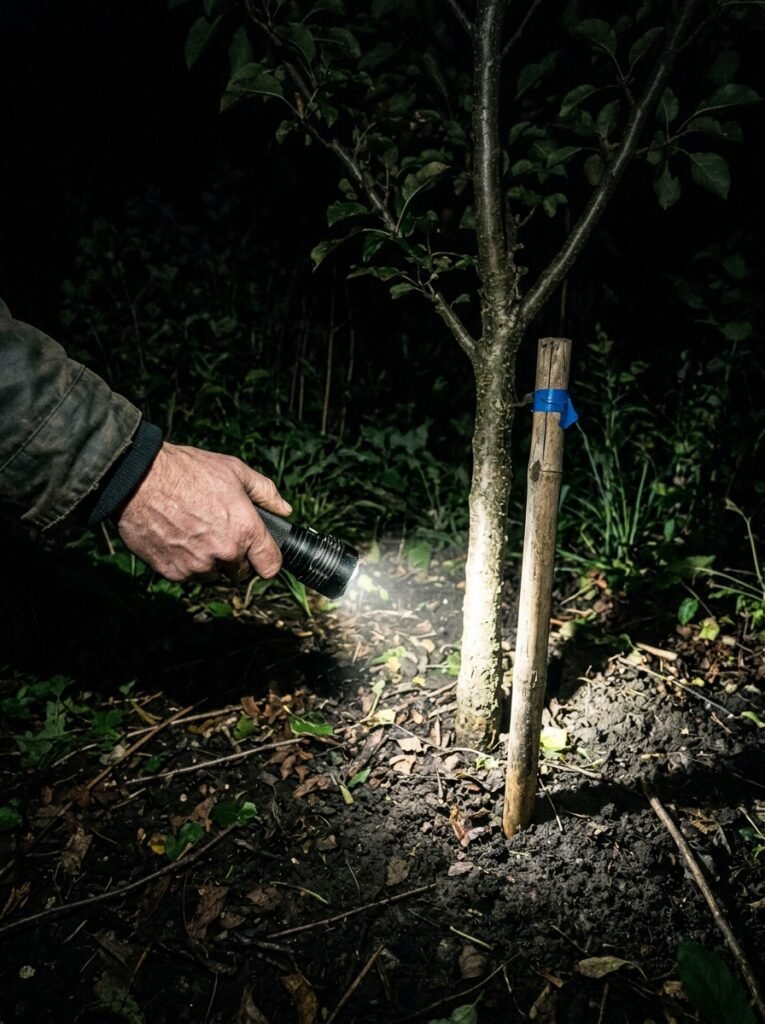
Wait for full dark. Take the brightest flashlight in the house, or a phone torch, and bring one other person.
Sit in the chair you use most. Have the other person hold the beam in different positions while you stay seated and watch what happens.
Try these positions:
- At the base of a tree, pointing up into the branches
- A hand span away from a fence or wall, pointing along the surface
- Behind a large plant, pointing at the fence behind it
- Held high, pointing down through leaves onto the ground
- Low and level with a path, pointing along it
Mark every position that works with a tent peg, a stone, or a bamboo stake pushed into the soil. Photograph each one on a phone as you go. Comparing three pictures the next morning is far easier than trying to remember three beams. By the end of the evening the whole layout exists on the ground, and no fixture has been bought yet.
Two things become obvious fast. The first is how little light a yard actually needs once eyes adjust. The second is how often a beam that looks lovely from standing height blinds anyone sitting down. If the source is visible from the seat, that position is wrong, however good the effect looks.
Questions Worth Settling Before Anything Is Bought
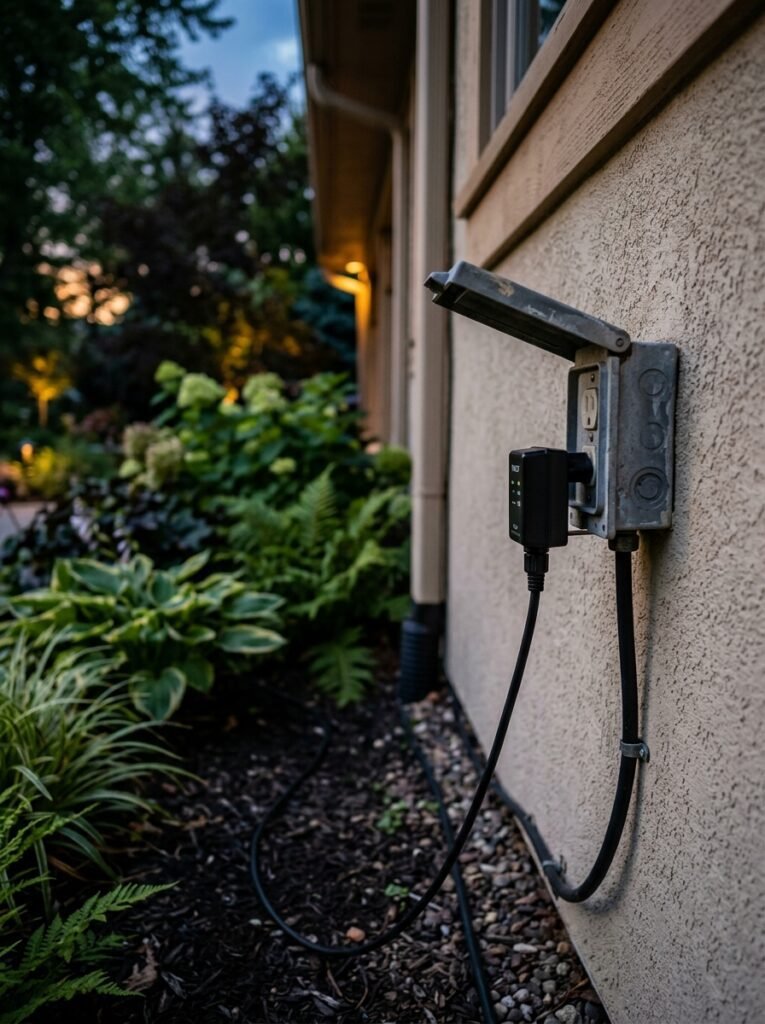
Where is the power coming from? This decides the whole plan. One protected outdoor outlet supports a plug-in transformer and a full low voltage layout. No outlet means either an electrician or battery and solar options only.
How many fixtures does an average yard need? Fewer than most people buy. Six to ten well aimed units cover a typical suburban yard. Twelve identical fixtures spread evenly usually look worse than five placed deliberately.
Is an electrician needed? Not for plug-in string lights or a 12 volt kit running from an existing outdoor outlet. Yes for new circuits, new outdoor outlets, or any permanently wired fixture.
Should the lights run all night? No. A photocell switches them on at dusk. A timer shuts them down at a set hour, so the yard is not glowing at three in the morning.
What is worth buying first? A decent transformer and two good fixtures, rather than a six pack of cheap ones. Two well aimed lights look considered. Six weak ones spread evenly look like an afterthought.
What about renting? Spike fixtures, clip-on lights and plug-in transformers all lift out with nothing buried and no holes drilled. Keep the cable under mulch rather than under soil so it comes back up cleanly.
Warm or cool bulbs? Warm, every time. Cool white drains the color out of planting and makes timber look gray.
Six Effects Worth Copying
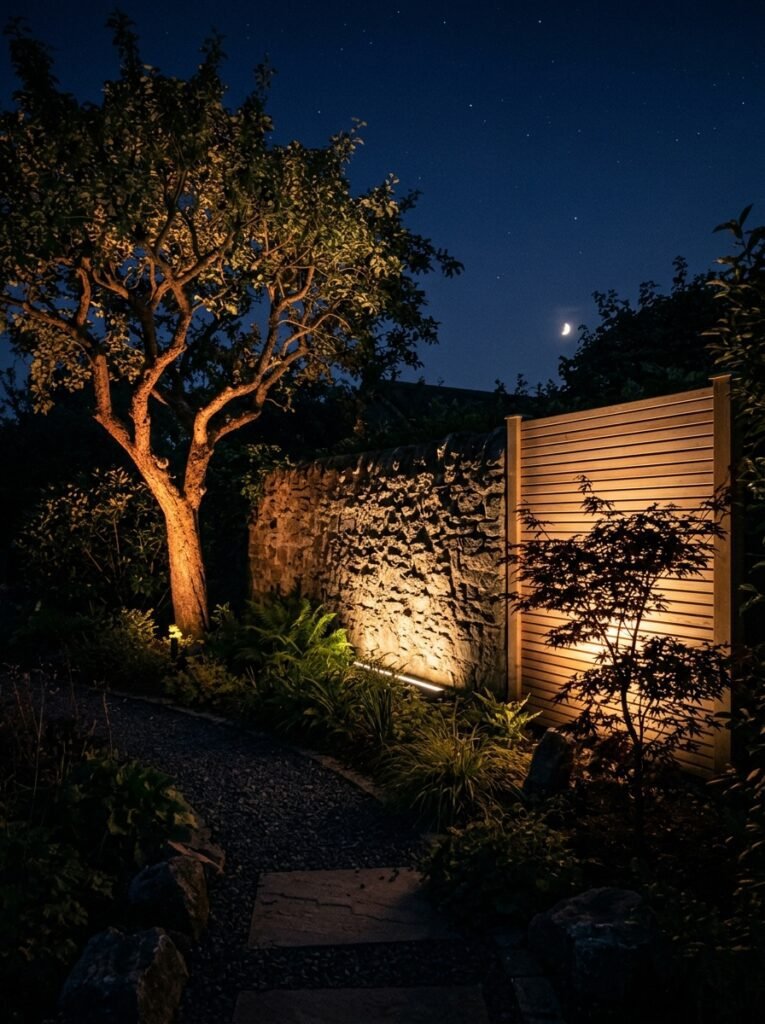
Almost every good lighting scheme is built from a handful of repeatable effects. Each one is defined by distance and angle rather than by which fixture gets bought.
Uplighting
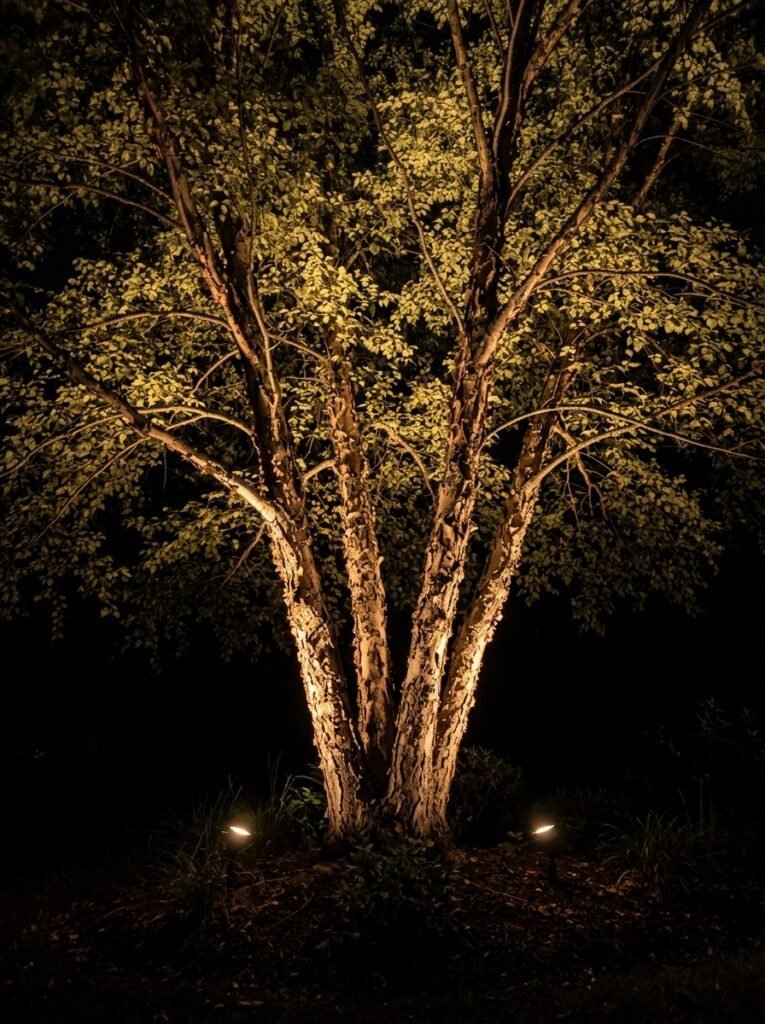
Set the fixture at the base of a tree, roughly 12 to 24 inches out from the trunk. Tilt it back toward the canopy. A narrow beam suits a single trunk. A multi stem tree looks better with two units on different sides. The branches then get modelled instead of flattened.
Aim into the canopy, not past it. Light that shoots straight up into the sky is wasted and lands on the neighbors.
Grazing
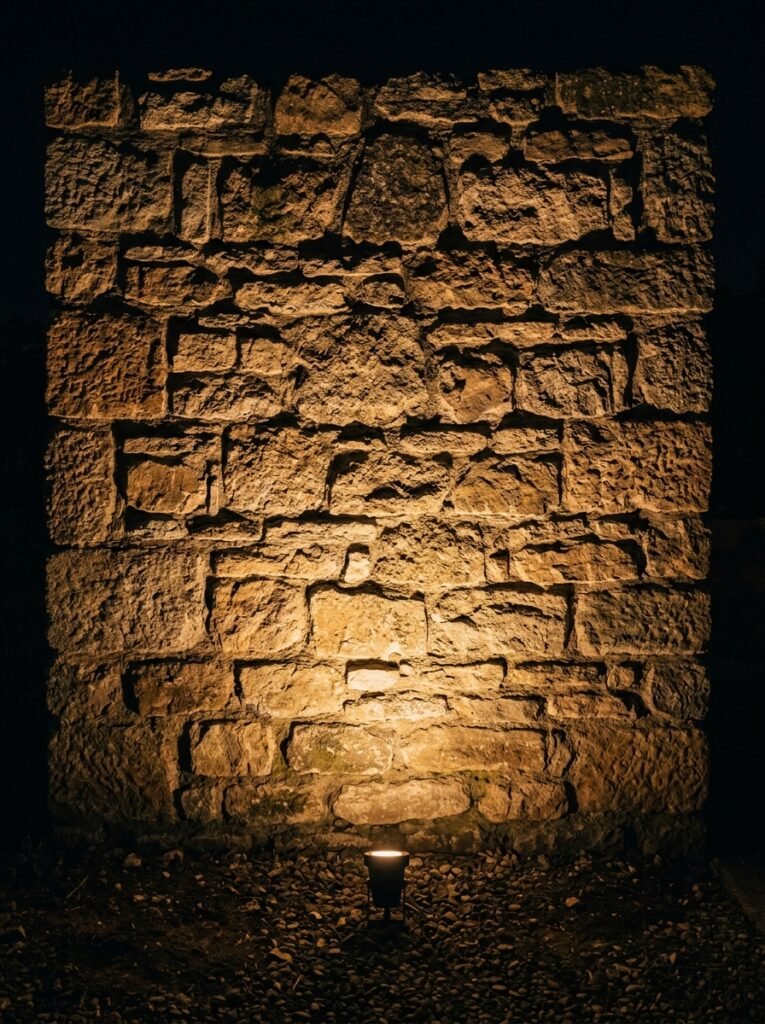
Set the fixture close to a wall, around 6 to 12 inches out. Aim almost straight up so the beam skims the surface. Every ridge and joint throws a small shadow, and the texture of brick, stone or rough timber jumps forward.
Closer means harder shadows and more drama. Smooth render and painted panels have nothing to catch the light, so grazing does very little for them.
Silhouetting
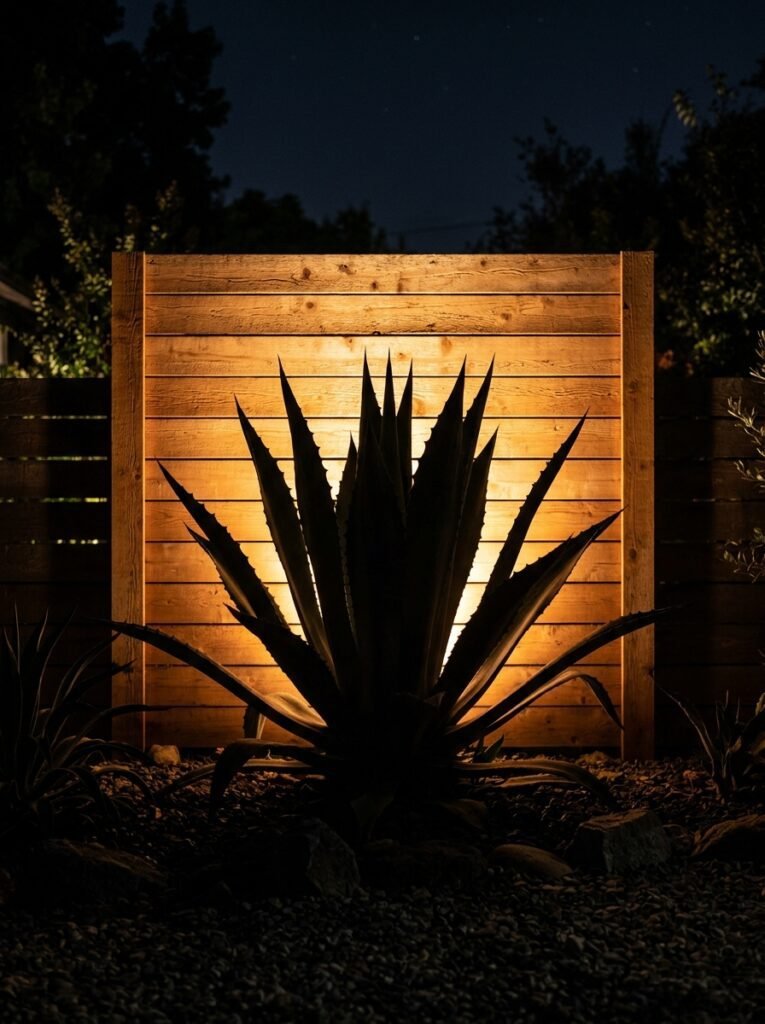
Light the surface behind an object rather than the object itself. A fixture tucked behind a sculptural plant, aimed at the fence, turns it into a dark outline. The panel behind it glows.
This works best with a strong profile: an agave, a fern, a bare branch structure, even a chair. It is the cheapest way to make a plain fence panel look intentional.
Moonlighting
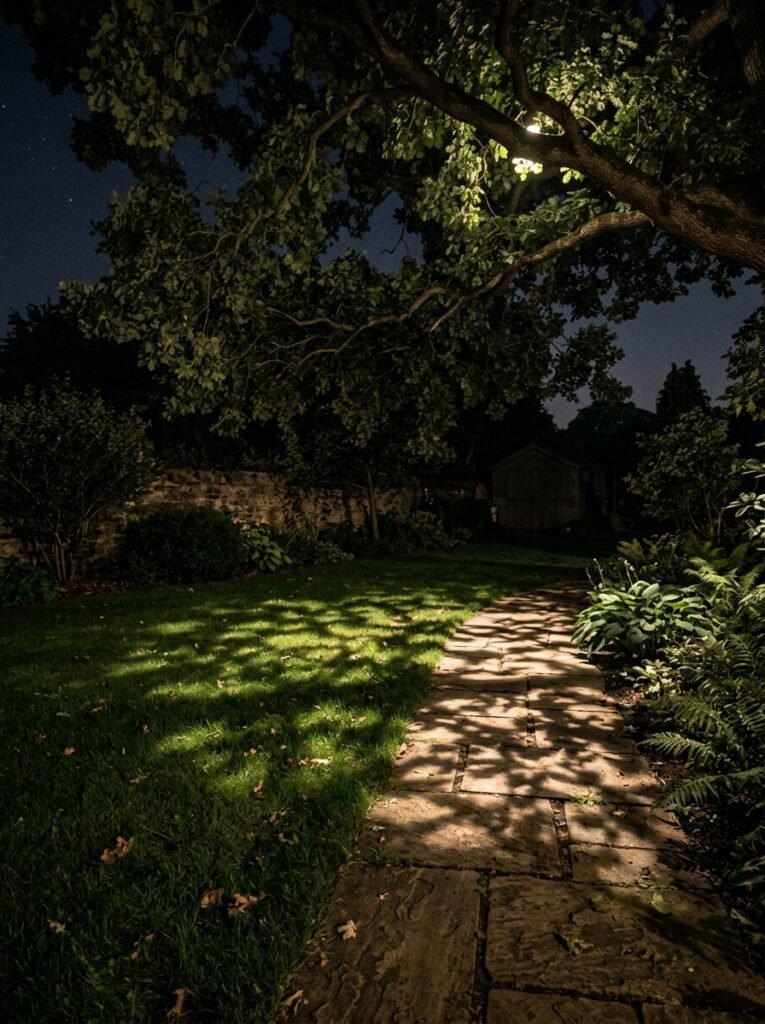
Fix a shielded downlight high in a tree or under a deep eave, at least 10 feet up. Aim it down through the branches. The leaves break the beam into dappled shadows on the ground below.
It reads as the most natural effect in outdoor lighting because it copies what moonlight already does. It also needs the least brightness of anything on this list.
Washing
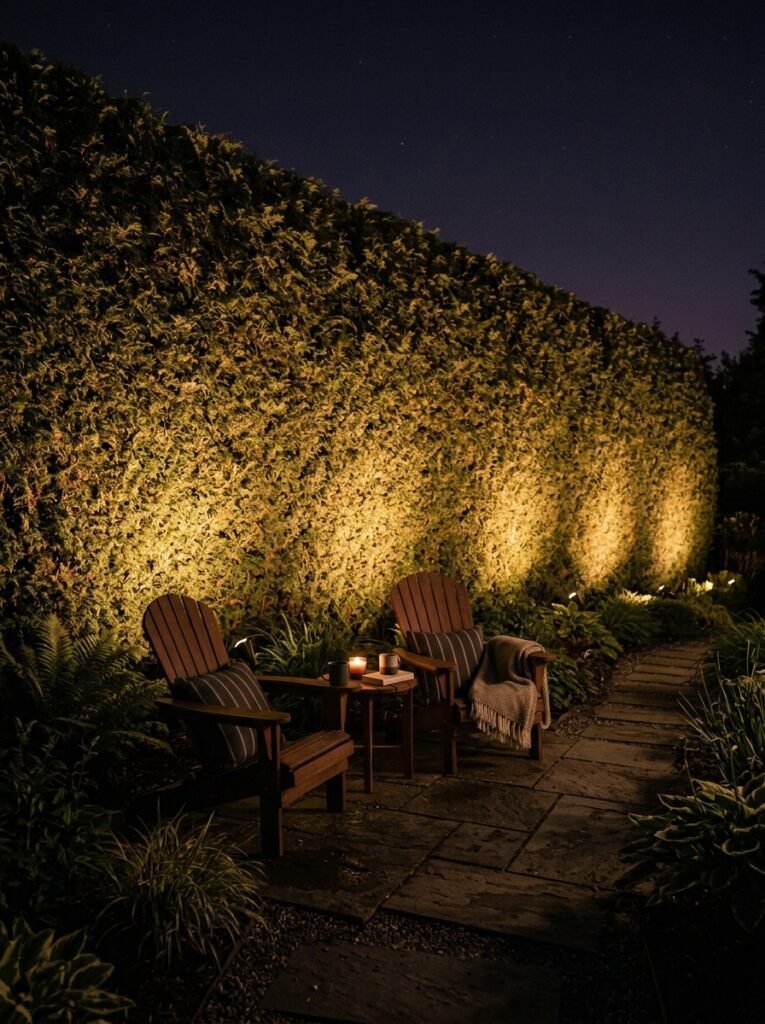
Set a wide beam further back from the surface so light spreads evenly rather than skimming. A wash lifts a hedge, a garage wall or a run of fence without picking out every bump.
Use it behind a seating area. Lighting the back of a yard pulls the eye through the space. The whole plot feels deeper than it is.
Pooling
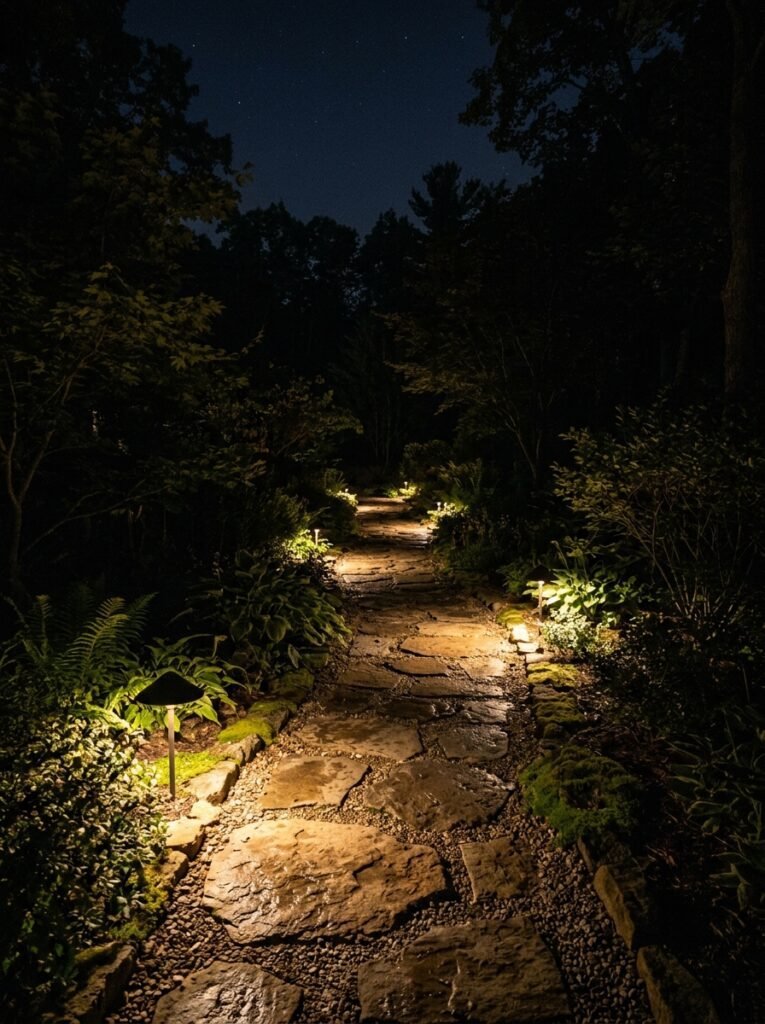
Along routes, aim for separate pools of light rather than continuous coverage. Low shielded fixtures or a downlight from a wall both work. Stagger them from side to side and leave genuine dark gaps between them.
The gaps are the point. Evenly spaced lights down both sides of a path produce a runway. Uneven pools read as a garden.
A rough starting spacing is one pool every 6 to 8 feet along the route. Then take every third fixture out and check whether the path still reads clearly. Usually it does.
Two effects is usually the ceiling in a compact yard, three at most. There is more on tight boundaries in this guide to a yard you can take in at a single glance.
What One Cable Run Can Actually Carry
Low voltage kits look plug and play, and mostly they are, until fixtures start getting added.
Add up the wattage of every fixture on a run and compare it against the transformer rating. Leave roughly a fifth of the capacity spare. That covers future additions, and a transformer running flat out runs hot.
Voltage drop is the other limit. It is why the last light on a long run looks dimmer than the first. Thin cable over a long distance loses voltage steadily. Manufacturers publish a chart for this, and it is worth reading before laying anything out.
Two habits prevent most problems:
- Run a heavier gauge cable as a spine and branch short spurs off it, rather than daisy chaining twelve fixtures in one long line
- Keep the cable under mulch or turf, mark the route, and photograph it before covering anything
Everything starts at one protected outdoor outlet, so decide where that outlet is before the layout gets finalized. A beautiful plan on the far side of the yard from any power is not a plan.
Timers, Curfews and the Neighbor’s Bedroom Window
Controls cost very little and get skipped more than any other part of a scheme.
A photocell handles switching on. A timer handles switching off. Together they mean nobody has to remember anything. The yard goes dark at a sensible hour instead of burning until sunrise.
Aim is the neighborly part. Fixtures should be shielded so the bulb is never visible from a normal standing or sitting position. Angle them down rather than out. The quickest check is to walk to the boundary and turn around. Look back at the yard from where the neighbors would see it.
DarkSky International and the Illuminating Engineering Society publish a short set of principles for responsible outdoor lighting. The summary is simple. Light only where it is needed, only when it is needed, no brighter than necessary, shielded and pointed down.
Motion sensors have one job, and it is security. A sensor on the seating layer that snaps on mid conversation is more startling than useful.
What Fails First
Outdoor lighting rarely dies all at once. It degrades, one fixture at a time, and the causes repeat.
- Connectors at ground level. Water wicks into a joint, corrosion follows, and the circuit fails. Gel filled waterproof connectors, joints kept above soil level, and a small drip loop in the cable prevent most of it.
- Plastic lenses. Ultraviolet light yellows and clouds them within a couple of seasons. Cast brass, copper and aluminium housings cost more once and then stop being a problem.
- Growth. Plants swallow beams. A fixture aimed perfectly in April can be lighting the back of a shrub by August, so re-aiming belongs on the spring list.
- Stakes. Frost lifts them, mowers clip them, string trimmers cut cable. Set fixtures a little back from mowing lines.
- Transformers. The cheapest ones have no thermal protection and no fuse worth the name. This is the component to spend on.
A twice yearly check covers almost all of it. In spring, clean lenses, re-aim everything, and tighten stakes. In fall, clear leaves off fixtures and check that cable has not surfaced.
Lighting the Yard You Only See From Indoors
For a good part of the year, the yard is something viewed through glass rather than stood in. That changes what to light.
A bright room next to a dark yard turns the window into a mirror. The fix is not brighter indoor lighting, it is having something to look at outside. Put light at the far end of the yard so the eye travels past its own reflection. Keep interior lamps near the glass dimmer than the rest of the room.
Winter is the season this pays off. Bare branch structure, evergreen shapes, fence texture and tree bark all light beautifully once the leaves are gone. A yard that looks flat in January under daylight can look better after dark than it does in July.
Blinds and curtains matter here too. A window left uncovered with a lit yard beyond feels open. The same window with nothing lit outside feels like a black panel. That is why so many people close the blinds the moment it gets dark.
The practical test takes two minutes. Switch everything on, go inside, and look from the sofa and the kitchen sink. Fixtures often need a small nudge to work from both the seat outside and the window inside.
After Dark, Less Does Almost All the Work
Three fixtures aimed carefully will beat twelve scattered around a yard, every time. Darkness between the lit areas is what gives a garden depth. Lighting everything evenly removes the contrast that makes it worth looking at.
If a scheme starts feeling flat, the answer is almost never another fixture. It is switching two off, or moving one, or dropping the brightness.
The flashlight is still in the drawer. It settles most arguments in about ten minutes.