Galley Kitchen Decor Ideas for a Narrow Kitchen
A galley kitchen is seen end-on. You walk in, and your eyes run straight down the corridor to whatever sits at the far end. That’s what makes galley kitchen decor different from decorating any other small kitchen. The far wall does more work than any other surface, and the two long walls matter mostly as a frame.
This Decorumy guide decorates a galley in that order. It starts with the type of galley you have, moves to the end wall, then the long walls, the light, the color and the floor. Our small kitchen decorating guide already covers runner width, counter space and plug-in strip lights, so this article stays on what’s specific to the galley shape.
The best galley kitchen decor ideas focus on the far end first. Give the end wall a clear focal point, such as a warm deep color, large art or a framed window. Keep the two long walls calmer and consistent, light the full length evenly and keep every decorative piece clear of the burners and the walkway.
What makes a galley kitchen different to decorate?
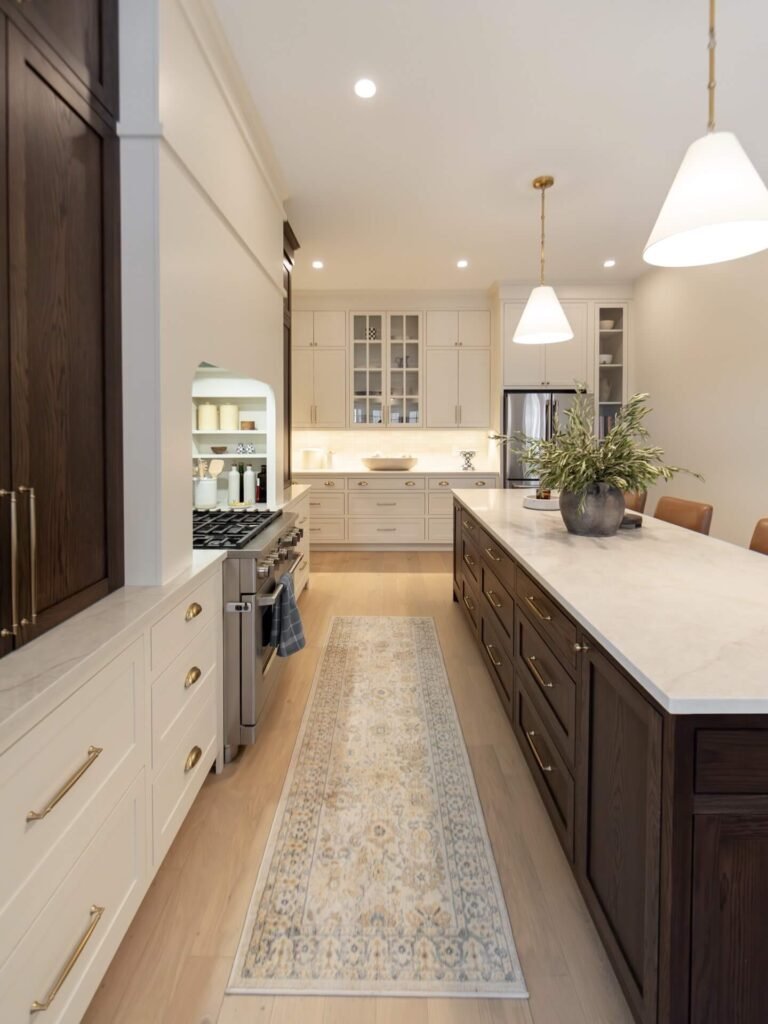
A galley kitchen is different because you see it as a corridor. Two parallel runs of cabinets face each other across a narrow walkway. From the entry, the long walls slide past at an angle, and the end of the room sits square in front of you.
That changes where decor pays off. A plant on the counter halfway down is seen sideways and briefly. A painting on the end wall is seen head-on every time you walk in. In most galleys the end wall is also the only stretch of wall that isn’t covered by cabinets.
The walkway sets the other limit. Nothing decorative can stick out into it at hip height, and nothing can sit where a cook will brush past it. For the recommended aisle widths and how to plan storage around them, see our guide to small kitchen storage.
Which kind of galley kitchen do you have?
Your galley type decides what the end wall is and how much of the kitchen people see from other rooms. Most galleys fall into one of three types:
| Galley type | What’s at the far end | Decor priority |
|---|---|---|
| Dead-end galley | A wall or a window | Make the end wall the focal point |
| Walk-through galley | A second doorway | Frame the view through the doorway |
| Open-ended galley | An opening into a living or dining area | Make the kitchen look tidy from the other room |
A dead-end galley gives you the most control, because you choose what sits at the end. A walk-through galley has no end wall, so the doorway frame and the view beyond it take that role. An open-ended galley is seen from the sofa or the dining table, so the run that faces that room needs to stay calm.
What should go on the end wall of a galley kitchen?
The end wall of a galley kitchen should hold one clear focal point that pulls the eye down the room. What that focal point is depends on what’s already there.
A blank end wall
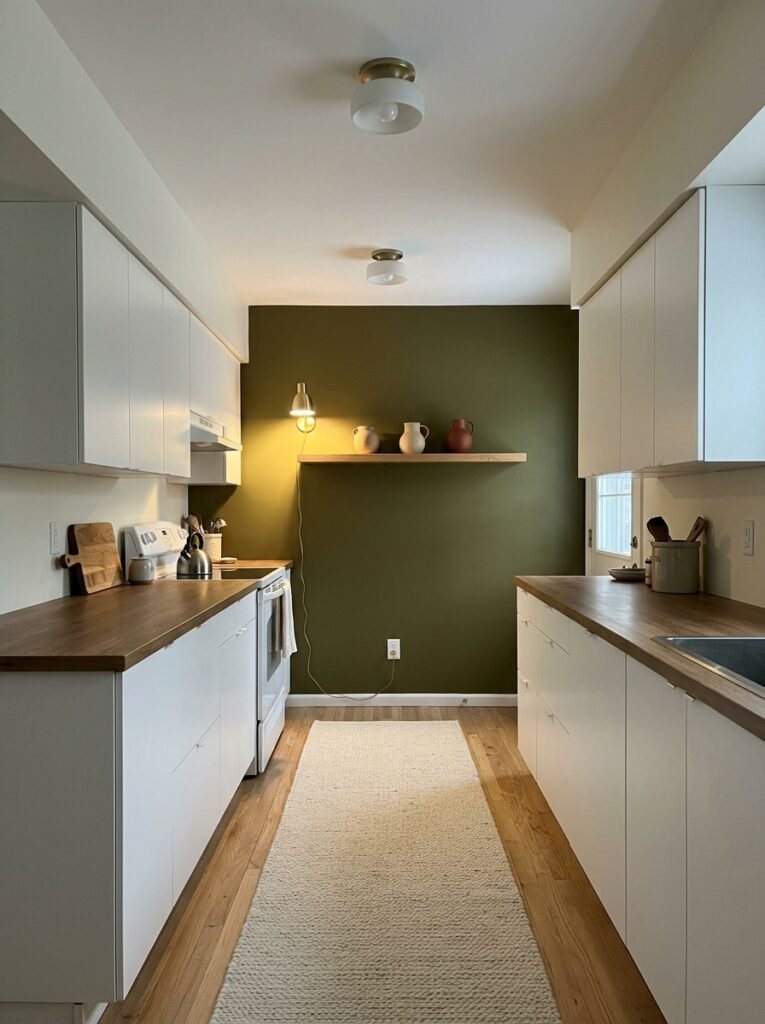
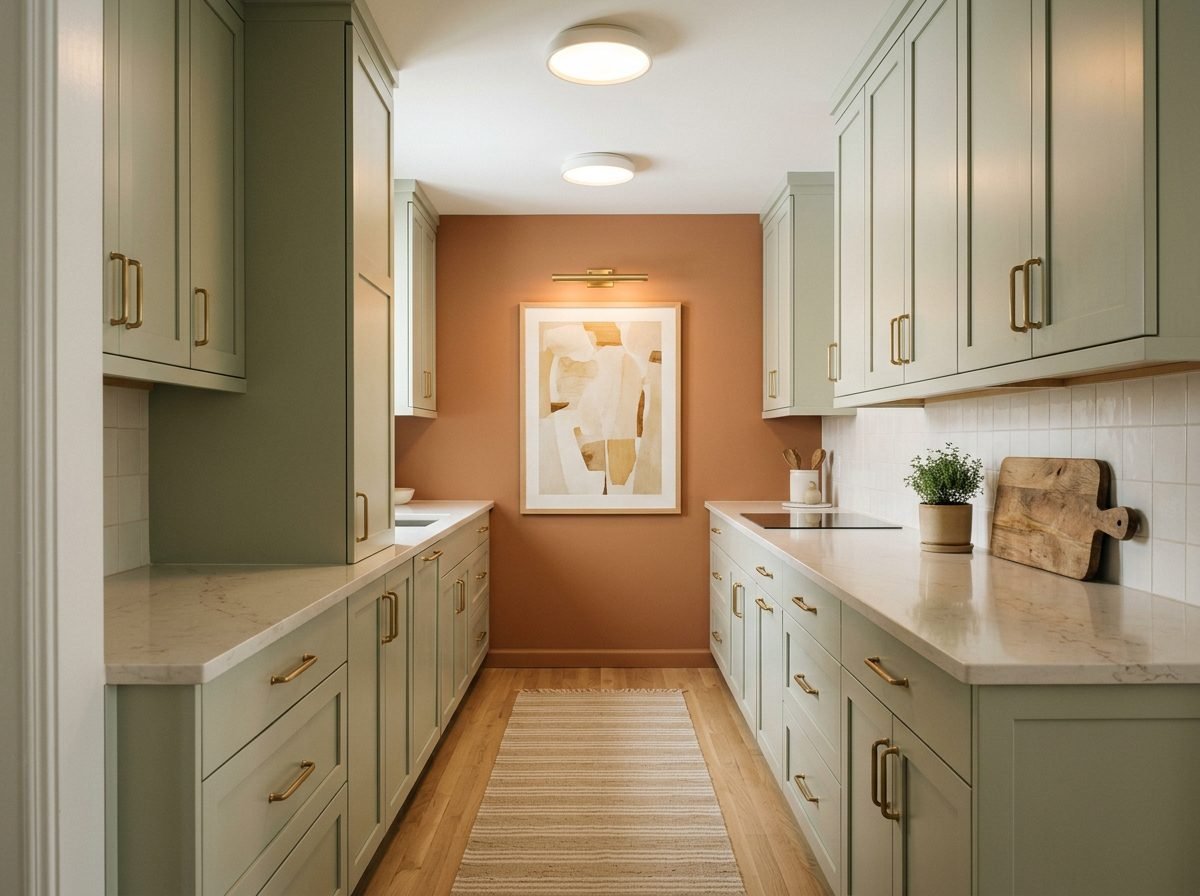
A blank end wall is the best canvas in a galley. Paint it a warm, deep color, or hang one large piece of art or a single open shelf with a few objects. Paint maker Resene notes that a warm, deep color on short end walls, with a lighter color on the longer walls, helps a long, narrow room look more evenly proportioned. That’s exactly the galley shape.
One large piece works better than several small ones here. Small frames read as clutter from the doorway, while one big piece reads clearly from the far end of the room.
A window at the end
A window at the end already works as a focal point. Your job is to frame it, not cover it. A simple shade or a short cafe curtain keeps light coming in. A painted window frame in a deeper color than the walls makes the window stand out from the doorway. If the window sits above the sink, keep the sill clear enough to clean, since splashes reach it.
A refrigerator or tall pantry at the end
A refrigerator or tall pantry at the end is harder to decorate. Keep the front clear of magnets and papers, since it’s the first thing you see. If there’s wall space beside or above it, use that space for the one decorative piece. A painted side panel or a framed print beside the fridge gives the eye something besides the appliance.
A doorway at the end
A doorway at the end turns the next room into your focal point. Frame the opening with a contrasting trim color, and think about what’s visible through it. A painting or a plant in line with the doorway makes the view feel planned.
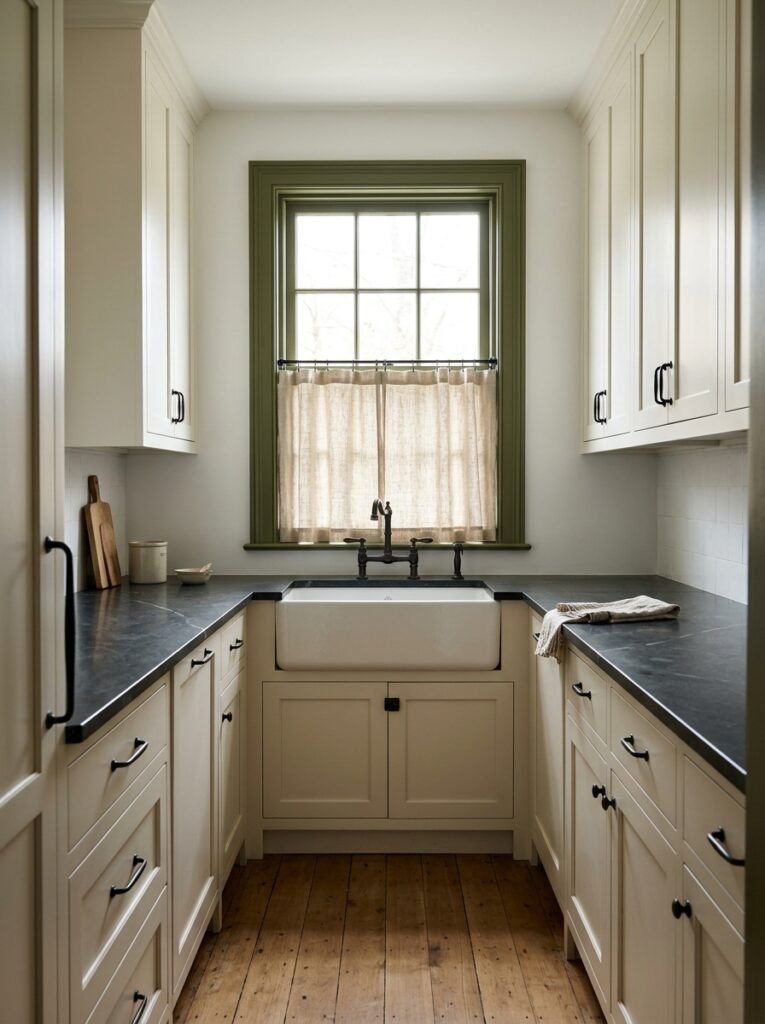
How do you decorate the two long walls?
The two long walls of a galley should stay calmer than the end wall. Most of their surface is cabinet fronts, and you see them at an angle as you walk in. Busy decor on both sides makes the corridor feel narrower.
Treat the two runs differently. Our small kitchen guide explains why one run should stay clear for prep while the other carries the styling. In a galley, pick the styled run by sightline. Style the run you see first from the doorway, and keep the cooktop run as plain as possible.
Consistency matters more than variety on these walls. Keep hardware in one finish on both runs. If you add a shelf or a rail, line it up with the top of the backsplash or the underside of the upper cabinets, so it reads as part of the kitchen. Small pieces that sit at different heights look scattered when you see them in a row.
Leave the wall space opposite the cooktop clear of anything that hangs down. In a narrow galley, the cook turns between the two runs all the time. A hanging plant, a towel bar with long towels or a tall utensil crock on the edge can catch an elbow.
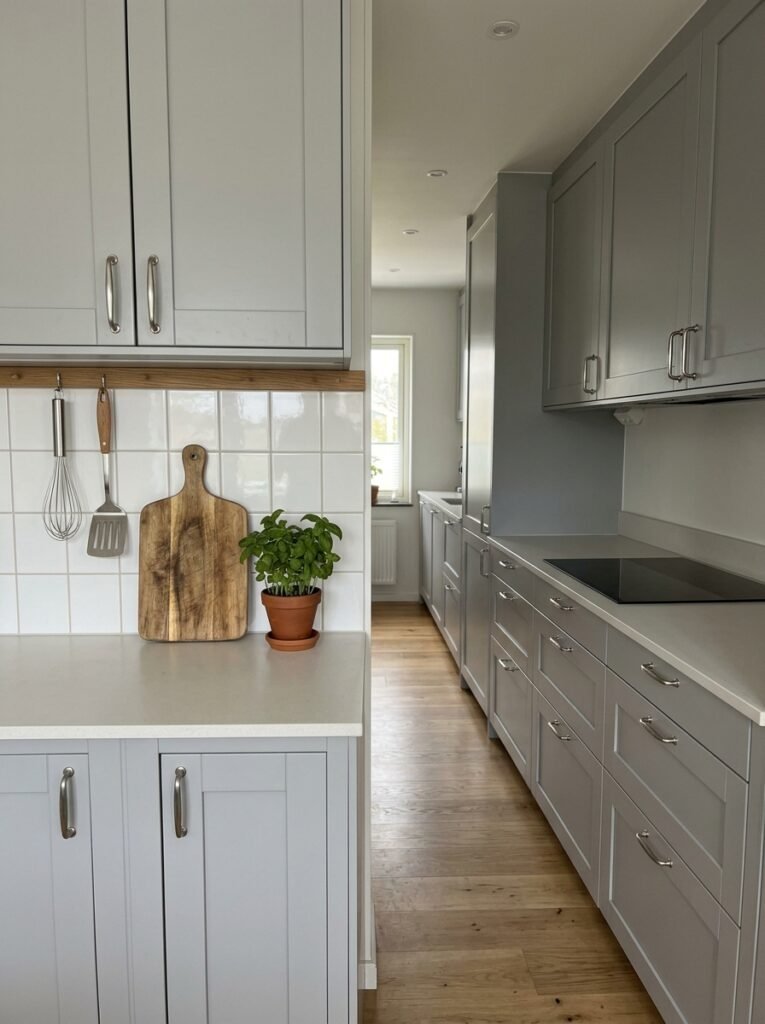
How should you light a galley kitchen?
A galley kitchen should be lit evenly along its whole length. A single ceiling fixture in the middle leaves both ends dim. That makes the room feel shorter in an awkward way, because the far end fades instead of drawing you in.
Two or three ceiling fixtures spaced down the center line spread the light more evenly. If you rent and can’t add fixtures, plug-in wall sconces near each end can fill the gaps without new wiring. Any new ceiling box or hardwired fixture should be installed by a licensed electrician.
Then give the end wall its own light. A picture light over a painting, a plug-in sconce beside a shelf or simply the window in daytime makes the far end the brightest point. The eye goes where the light is.
A light-colored ceiling helps too. University of Florida Extension notes that light-colored ceilings reflect more light than dark ones and make a room appear higher. In a galley, that bounced light also reaches the counters between the fixtures.
Quick answers about galley kitchen decor
Should a galley kitchen be painted light or dark?
A galley kitchen usually works best with light long walls and a deeper color on the end wall. The light long walls keep the corridor from closing in. The deeper end wall draws the eye and makes the room feel less like a tunnel. Dark colors on every wall can work, but they need strong, even lighting.
Can I put art in a galley kitchen?
You can put art in a galley kitchen, and the end wall is the best place for it. One large piece reads well from the doorway. Small pieces along the long walls are seen at an angle and tend to look like clutter. Keep any art away from the cooktop, where heat and grease build up.
Do mirrors work in a galley kitchen?
A mirror can make a galley feel longer, but it reflects whatever sits opposite it. On an end wall facing the doorway, it mostly reflects the corridor and the cabinets. If the counters are often busy, the mirror doubles the clutter. Art or color is usually the safer choice.
How do I make a galley kitchen feel less like a hallway?
Give the far end a destination, keep the long walls calm and light the room evenly. A hallway feels like a hallway because nothing invites you to the end. A deep end wall color, one strong piece of art and a light that makes the far end bright change that.
What colors work in a galley kitchen?
The colors that work best in a galley kitchen are lighter tones on the long walls and a warmer or deeper tone on the end wall. That split comes from how color changes apparent distance. Warm, deep colors tend to look closer. Light, cool colors tend to look farther away.
In a galley, you want the long walls to look farther apart and the end wall to look a little closer. Pale, cool or soft neutral tones on the long walls do the first job. A warm color on the end wall, such as terracotta, deep ochre, warm green or brick red, does the second.
The cabinets may already decide much of this, especially in a rental. If the cabinets are dark, keep the walls and ceiling light, and use the end wall color as the main accent. If the cabinets are white or pale, you have more freedom with the end wall.
Keep the ceiling the lightest surface in the room. It bounces light down onto the counters and keeps a narrow room from feeling boxed in.