Small Kitchen Storage Ideas to Make Room for Everything
Small kitchens get blamed for problems that are really about layout, not square footage. A cramped feeling usually means the space is working against you: the things you reach for daily are buried behind things you use twice a year, the counters carry items that belong in a cupboard, and half the room’s real capacity sits empty above eye level or hidden in a corner nobody opens.
Most small kitchens hold far more than they look like they can. The job is finding the storage that already exists and putting it to use. What follows walks through the places that room tends to hide, and the low-cost fix for each one. Almost none of it needs a contractor, and a good share of it works in a rental.
Start by taking everything out
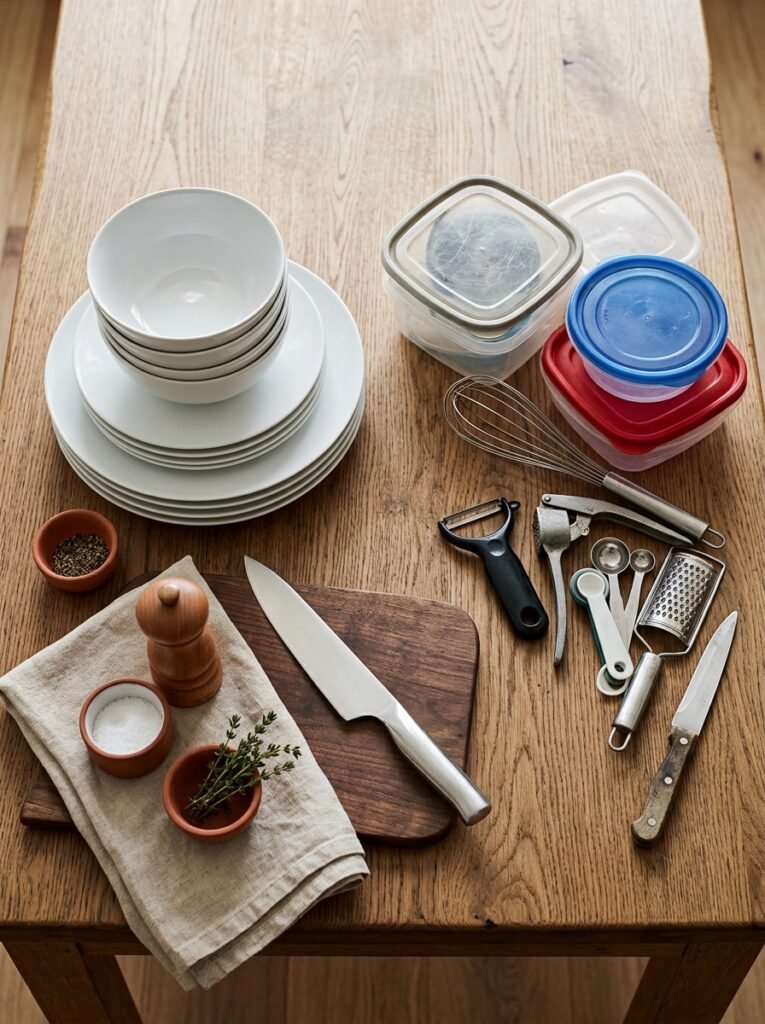
Before buying a single organizer, empty the cabinets and drawers onto the table. Seeing all of it in one place is the quickest way to spot what you own two of, what you have not touched since moving in, and what quietly holds prime space for no reason.
Sort as you go. Keep the tools and dishes that earn their spot through regular use. Set aside duplicates, the gadgets bought for one recipe, chipped mugs, and lids whose containers vanished years ago. Single-use items are the worst offenders in a tight kitchen, because each one claims room a versatile tool could share. A solid pot, a sharp knife, and a good pan cover most of what a novelty slicer promises.
Whatever survives the sort goes back in with a plan, not wherever it happens to fit. That plan is the rest of this article. Clearing out first matters because no clever container rescues a cabinet stuffed with things you never use. If a cramped bathroom is next on your list, the same edit-it-down move pays off there too, and these small bathroom decor ideas start from exactly the same place.
Store things where you reach for them
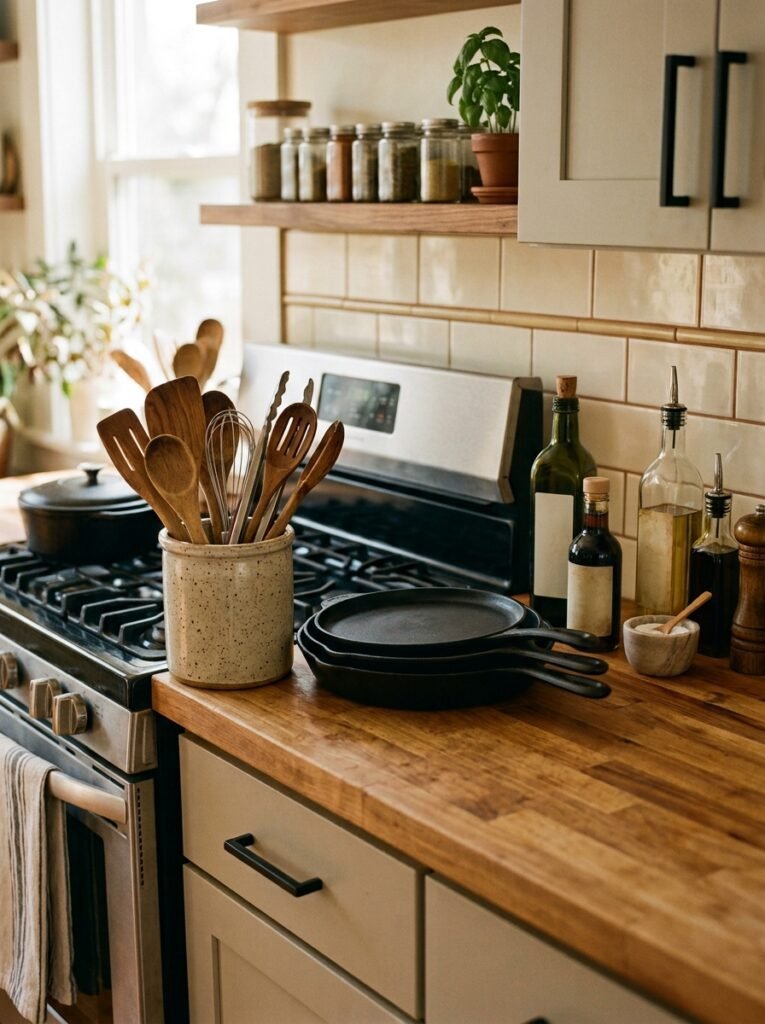
A kitchen feels twice as usable when everything lives close to where it gets used. Keep pots, oils, and cooking spoons within a step of the stove. Put everyday plates, glasses, and mugs beside the sink or dishwasher so unloading is one short move. Keep knives, boards, and mixing bowls together in the prep zone between the two. Coffee and its mugs belong in a single spot, not scattered across three cabinets.
Grouping by task does more than save steps. It frees up the odd cabinet you were treating as a catch-all, since items stop landing at random. It also keeps the floor clear, which matters more than it sounds. The path between your sink, stove, and refrigerator carries most of the traffic in any kitchen, and the National Kitchen and Bath Association recommends a work aisle of at least 42 inches for one cook and 48 inches where two people share the space, plus a simple walkway of at least 36 inches. Bins and bulky appliances parked on the floor cut straight into that clearance, so storage that hangs, stacks, or tucks away is worth more in a small room than anything that has to sit underfoot.
Turn your walls into storage
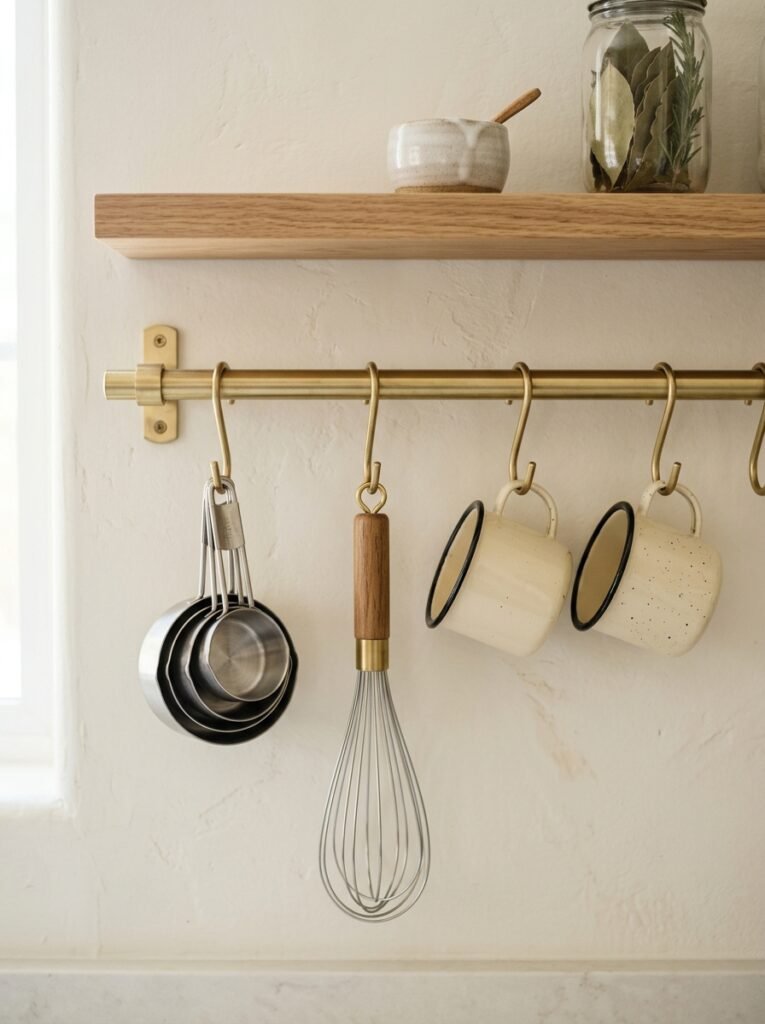
Floor and cabinet space runs out long before wall space does. The vertical surfaces in a small kitchen are usually its most wasted storage.
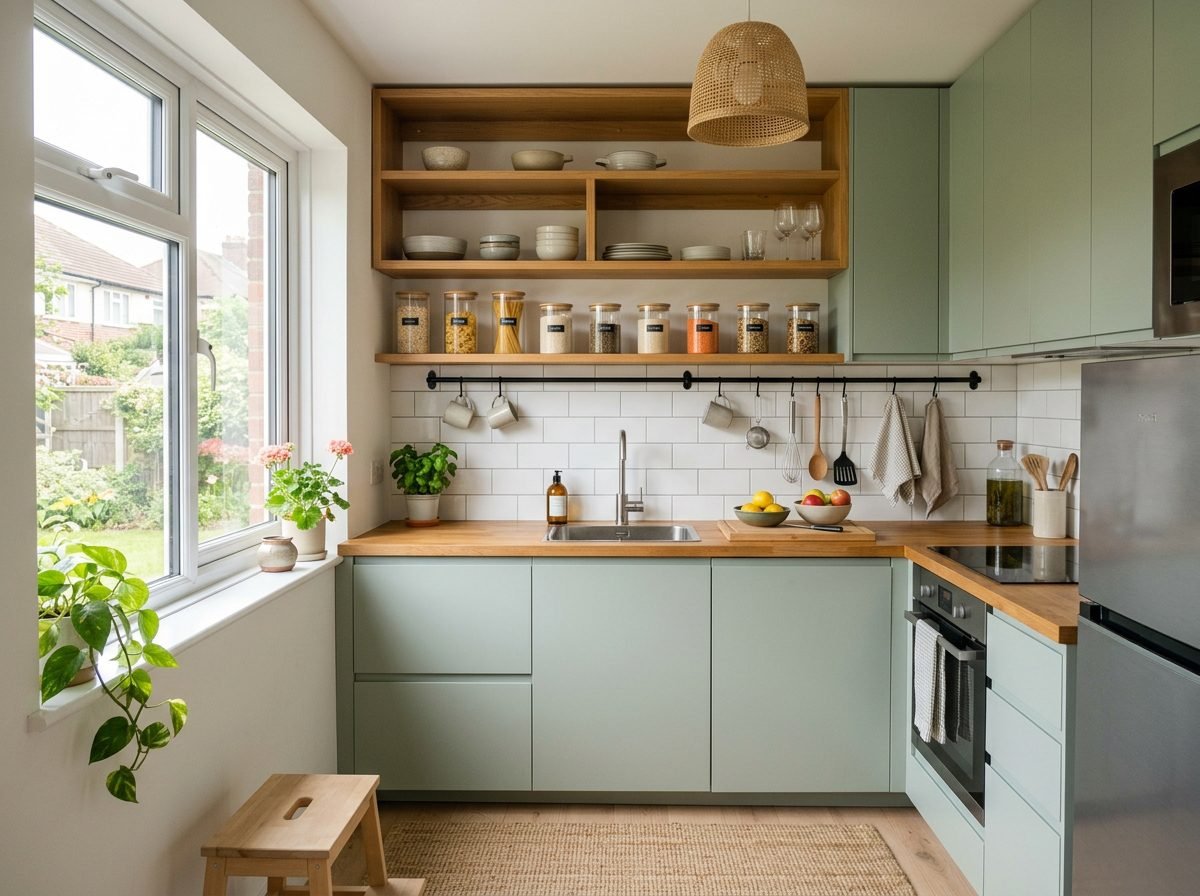
A rail mounted along the backsplash and fitted with S-hooks holds utensils, mugs, measuring cups, and small pots off the counter and in easy reach. A magnetic strip keeps knives visible and empties a drawer at the same time. A pegboard on a bare wall or the end of a cabinet run stays endlessly adjustable, with hooks and small shelves that move wherever the next thing needs to go. Even a couple of hooks screwed to the underside of a wall cabinet turn dead air into a home for mugs.
The strip of wall above your upper cabinets is prime territory for whatever you rarely need. Baskets or matching bins up there hold the roasting pan, the platters that only appear on holidays, and the appliance you drag out once a month, keeping all of it clear of the cabinets you open every day. Whenever you mount something that carries weight, drive the screws into studs rather than drywall alone, and check what each rail or hook is rated to hold before loading it.
Rework the space inside your cabinets
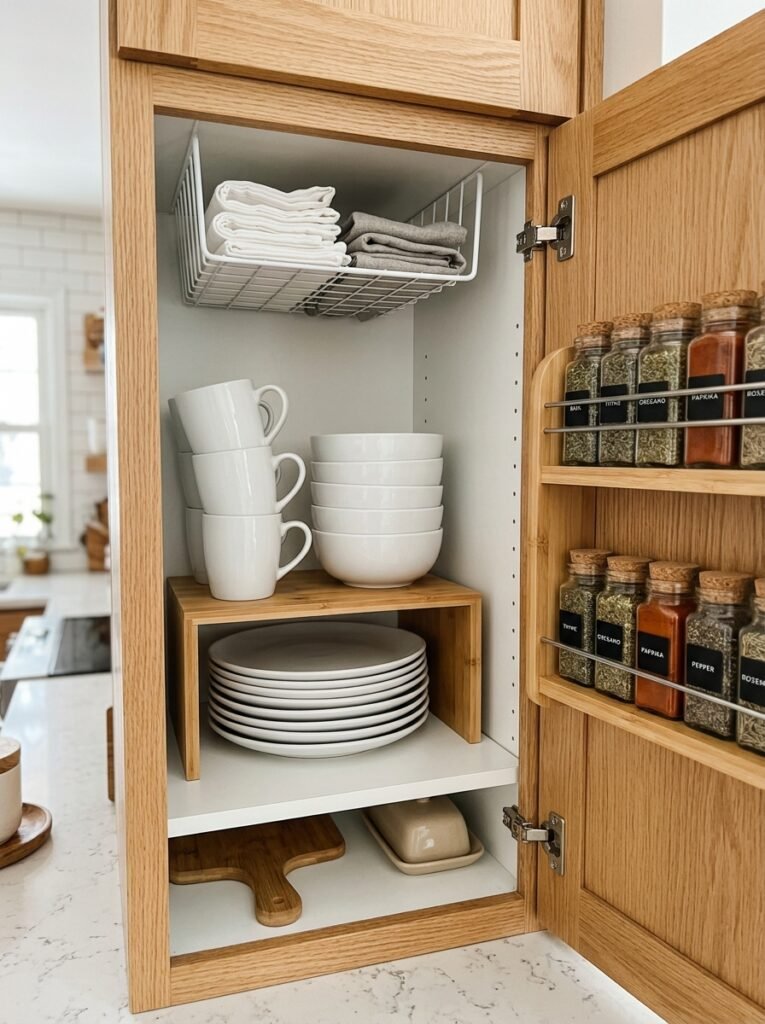
Open a typical cabinet and most of what you see is air. One fixed shelf leaves a tall empty gap above every short stack of plates or row of glasses, and reclaiming that gap is where a small kitchen finds a surprising amount of room.
Shelf risers and stacking shelves split one shelf into two levels, so cups sit above plates instead of teetering beside them. Under-shelf baskets clip onto an existing shelf and hang below it, adding a layer for napkins, foil, or tea bags with no tools at all. The inside of a cabinet door counts as storage too: a slim rack mounted there holds pot lids, cutting boards, foil boxes, or a row of spices that would otherwise sprawl across a shelf. A turntable set in the corner of a cabinet brings oils, vinegars, and sauces to your fingertips with one spin, so nothing gets marooned at the back. The idea behind all of it is the same. Find the empty vertical space inside each cabinet and add a layer to fill it.
Stop wasting the corner
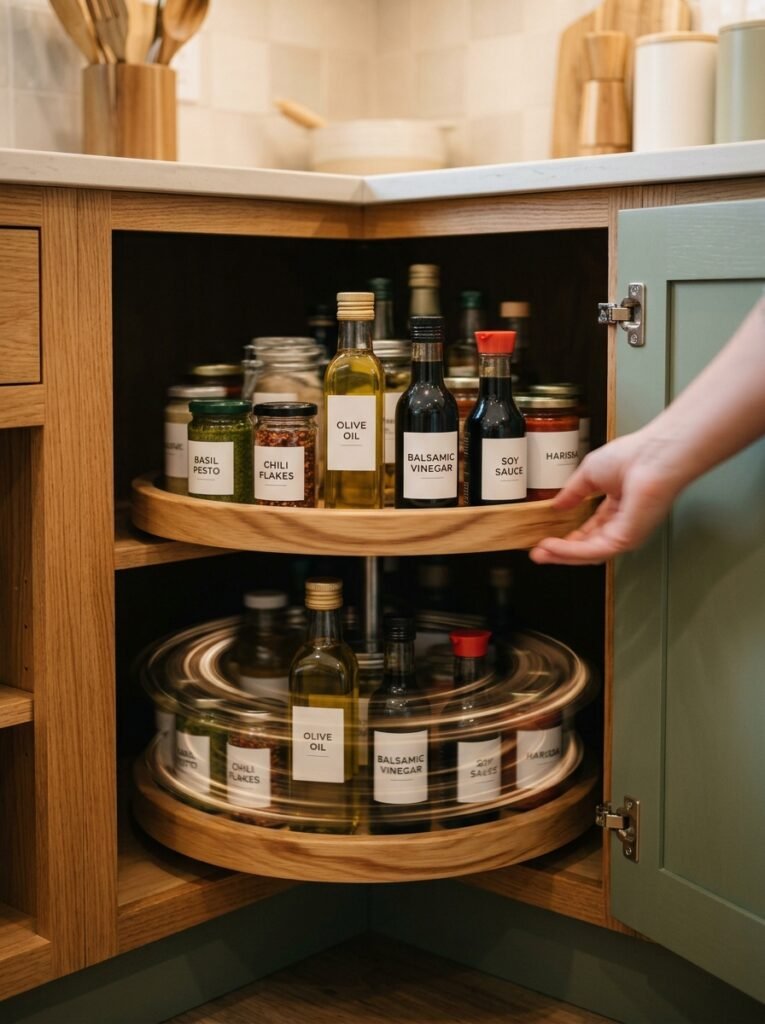
Corner cabinets swallow more storage than any other spot in the kitchen, mostly because anything that slides to the back becomes impossible to reach. That deep, dark space usually ends up holding one lonely pot and a lot of nothing.
A lazy Susan is the simplest cure. Set one inside the corner cabinet and a quick turn brings the back around to the front, so the whole shelf pulls its weight. For base corners, pull-out or swing-out fittings roll the entire contents into the open, though they cost more and suit a renovation better than a weekend change. If new hardware is not in the budget, at least give the corner a job that does not need daily access, like holding the slow cooker, a stockpot, or bulk supplies you retrieve in one trip each week.
Get more out of your drawers
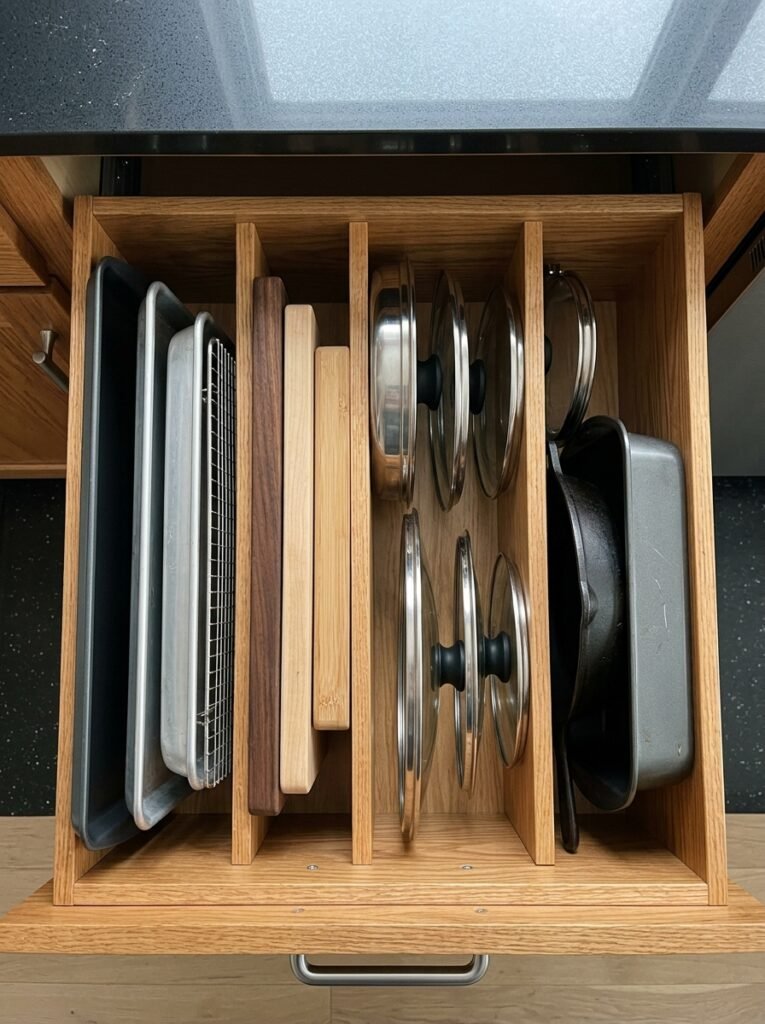
A deep drawer with everything loose inside is a small kitchen running at half capacity. Add dividers and that same drawer holds far more, because each tool gets a lane instead of drifting into a pile.
Adjustable dividers or a set of organizer trays keep utensils, knives, and gadgets sorted and end the daily dig. The bigger win is storing flat items on their edges instead of in a stack. Baking sheets, cutting boards, muffin tins, and pot lids all take up less room and stay far easier to grab when they stand upright, filed side by side like books. A few tension rods stood vertically in a deep drawer, or a purpose-made rack, holds them in place. Pot lids in particular stop being the thing you wrestle with every time you cook once each one has its own slot.
Put the sink and window to work
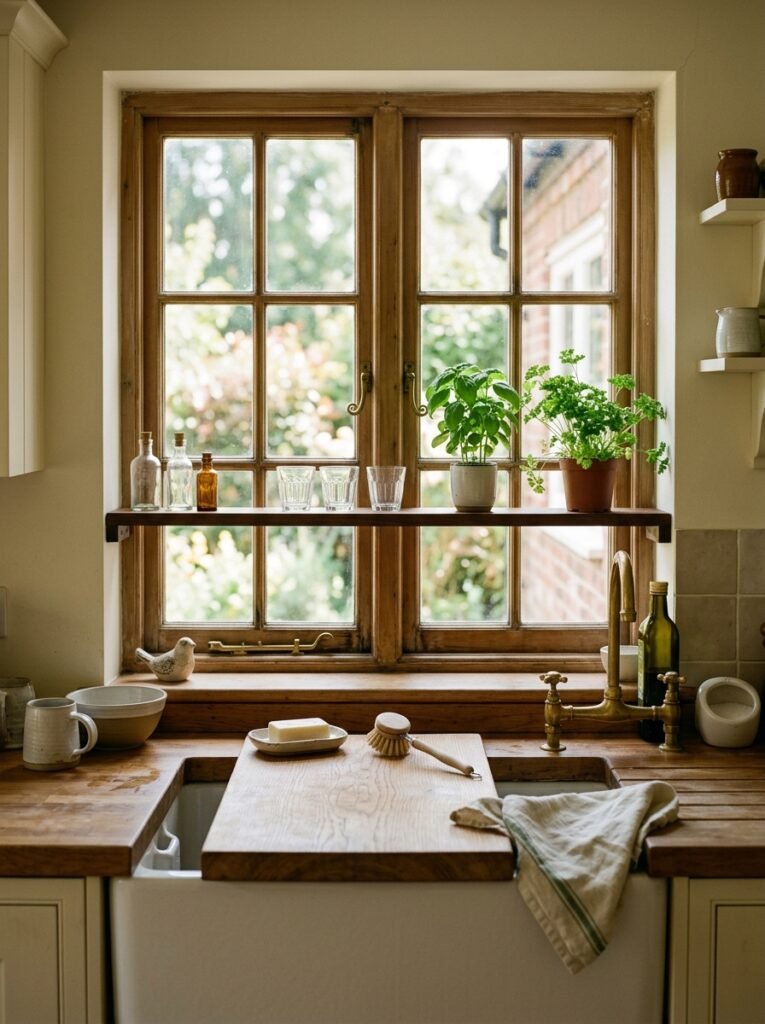
The area around the sink holds capacity most kitchens ignore. A board or rack that sits across the basin adds a working surface exactly where counter space runs shortest. Rest a colander on it to drain, use it as an extra cutting station, then lift it off when you want the sink back.
A window over the sink is a chance for a slim shelf across the frame, set high enough to clear the glass, holding a few glasses, a plant, or jars of herbs where they catch the light. Under the sink tends to be a tangle of bottles, but a short tension rod fixed across the cabinet lets spray bottles hang by their triggers and frees the cabinet floor for everything else. A small caddy or a suction holder on the basin wall keeps the sponge and brush from crowding the counter edge.
Fill the awkward gaps
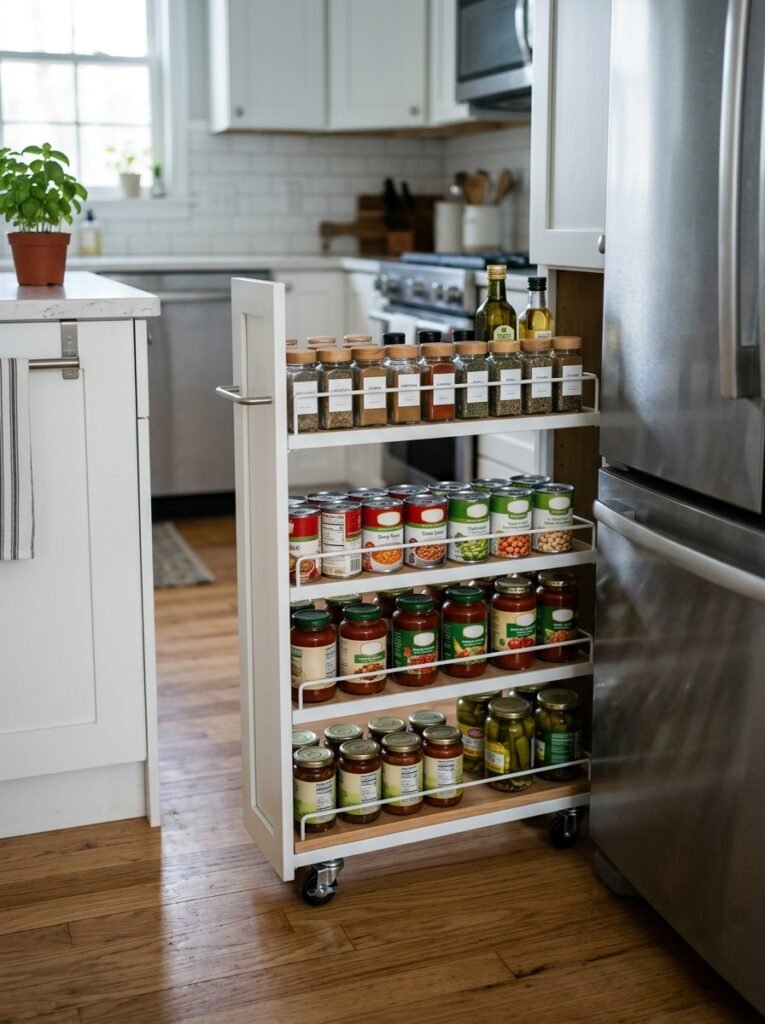
Every kitchen has slivers of space that look too narrow to use. A gap of a few inches beside the refrigerator or at the end of a cabinet run fits a slim pull-out cart on wheels, the kind with narrow shelves built for cans, bottles, or spices. Rolled out, it puts everything in view; pushed back, it disappears.
Doors are another surface people forget. An over-the-door organizer on a pantry or cabinet door holds wraps, cleaning supplies, or snacks in pockets that would otherwise need a shelf. Adhesive hooks on the exposed side of a cabinet give dish towels, oven mitts, or an apron a place to live. The top of the refrigerator, usually left bare, takes a couple of baskets for lunch bags, cookbooks, or the bread you want off the counter. No one of these spots is large, but together they soak up a real share of the clutter that would otherwise pile up in the open.
Add a surface you can move
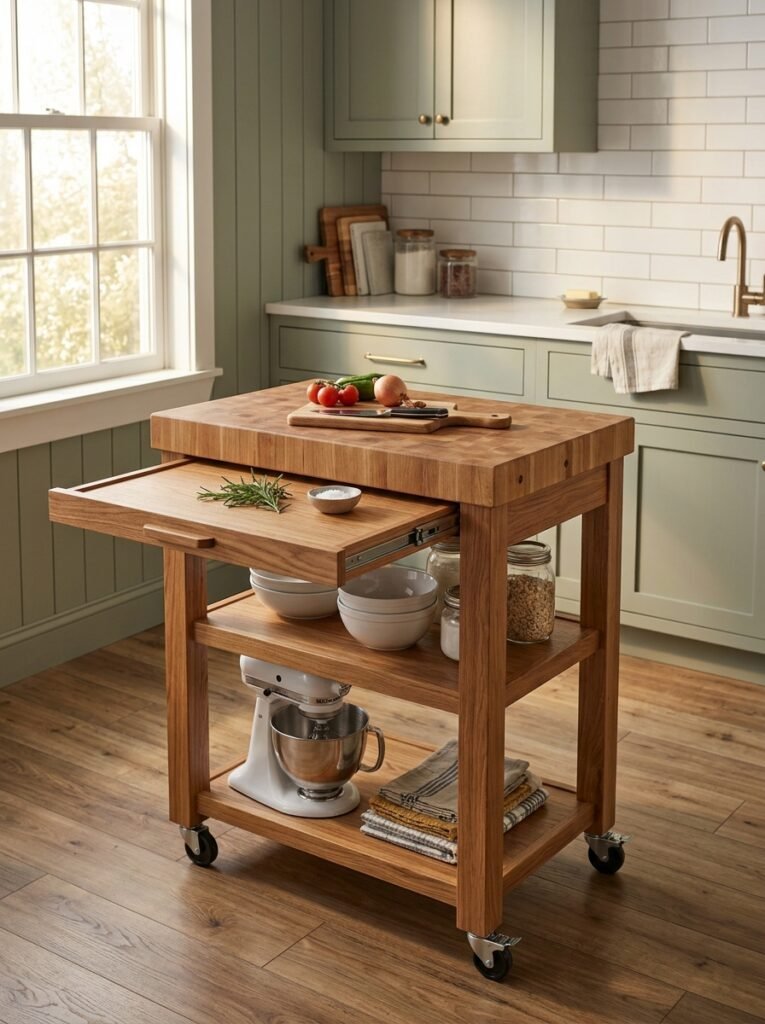
When counter space is the real shortage, a piece that rolls solves two problems at once. A compact kitchen cart or a small butcher-block trolley gives you extra prep surface on top and shelves or drawers underneath, then wheels into a corner or against a wall when the cooking is done. A drop-leaf table or a fold-down wall shelf pulls the same trick where even a cart will not fit, opening up when you need it and folding flat when you do not. In a tight kitchen, the most valuable surface is often the one that does not have to stay in the same place all day.
Keep your food storage in order
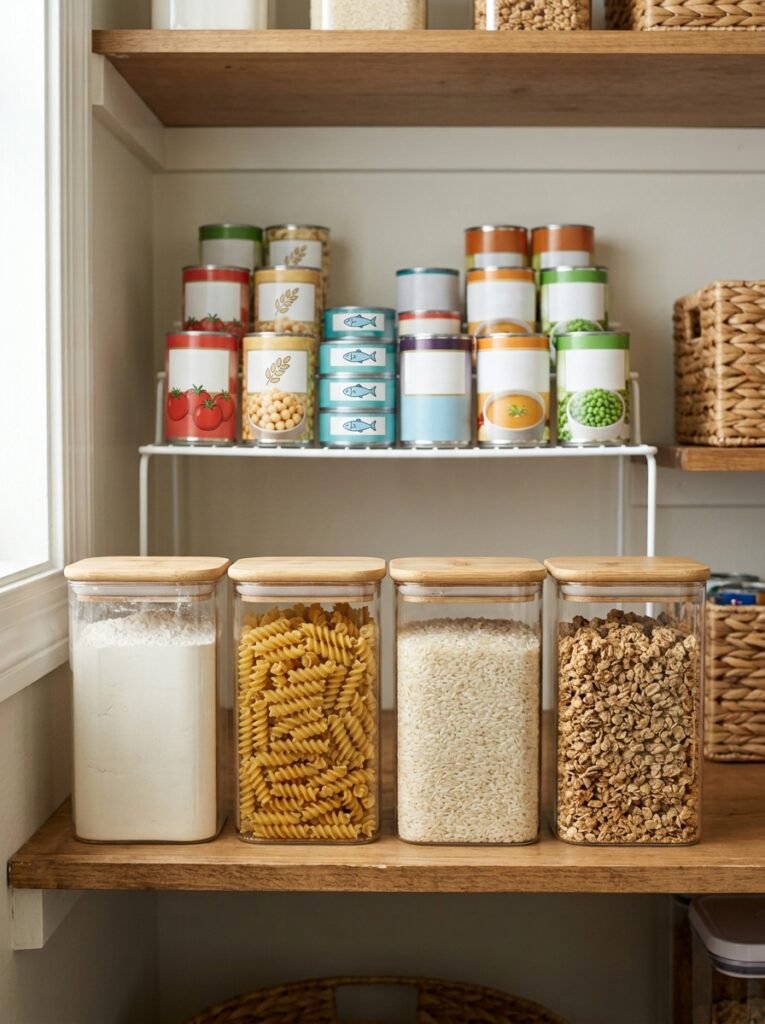
Food takes up more room than it needs when it stays in its original boxes and bags. Half-empty cereal cartons, floppy bags of flour, and mismatched packaging waste space and never stack cleanly. Moving dry staples into square or rectangular airtight containers fixes both issues at once: they stack without gaps, and clear ones let you see what is running low at a glance. Packing food this way keeps it fresher too, since dry goods hold their quality best in tightly closed, airtight containers kept below 85 degrees, ideally in the cooler 50 to 70 degree range, and away from humidity that turns them stale.
Where you keep food matters as much as how you pack it. Shelf-stable items last longest somewhere cool, dry, and dark, and the USDA specifically warns against storing them above or beside the stove, under the sink, or anywhere damp, because heat and moisture shorten their life. Give cans a tiered shelf or a small riser so the back rows stay visible, move older items to the front so nothing hides past its date, and leave a little breathing room on each shelf instead of cramming it, which keeps the whole store easy to read and use.
Bringing it together
A small kitchen rarely needs to be bigger. It needs its existing space used all the way, out to the walls, into the corners, up the doors, and off the floor. Pick the spot that frustrates you most, the overflowing drawer, the corner you dread, the counter you can never keep clear, and fix that one properly before moving on. Progress in a small kitchen tends to snowball, because clearing one bottleneck gives the space around it somewhere to put things. The goal is plain: you should be able to reach what you use without shifting three things you do not, and put it back just as easily. With everything in reach, the room is finally ready for the finishing layers, which is where these kitchen decor ideas that survive real cooking take over.
FAQ
How can I get more storage in a small kitchen without renovating? Focus on space you already have but are not using. Mount a rail or pegboard on an empty wall, add shelf risers and under-shelf baskets inside cabinets, fit a rack to the inside of cabinet doors, and stand flat pans and boards upright in drawers. A slim rolling cart in a narrow gap and an over-the-door organizer add real room with zero construction.
What is the best way to store pots and pans in a tight kitchen? Hang the ones you use most on a wall rail with S-hooks or on hooks under a cabinet, and store the rest by standing lids and shallow pans upright in a deep drawer so they file like books. Nesting pots inside one another saves space, and a turntable or pull-out keeps a corner cabinet from swallowing the bulky pieces.
Where should I keep things I hardly ever use? Send them to the spots that are awkward for daily items but perfectly fine for occasional ones: the shelf above your wall cabinets, the back of a corner cabinet, or baskets on top of the refrigerator. Moving rarely used pieces out of easy-reach space frees it for the tools and dishes you handle every day.
How should I store dry food to save space and keep it fresh? Move staples like flour, rice, pasta, and cereal into square, airtight containers that stack without gaps, and choose clear ones so you can see what is low. Keep them somewhere cool and dry, below about 85 degrees and out of humidity, which is where dry goods hold their quality best. Store shelf-stable food away from heat, and not above or beside the stove.