Creative Small Dining Room Ideas That Make a Big Impact
Small dining rooms usually get treated as a problem to be minimized. Pale walls, a compact table, bare surfaces, and a general effort to make the room apologize for its size.
That instinct is backwards. A dining room is the one room where being bold carries almost no risk. The reason has nothing to do with taste. It is a scheduling fact.
The Room You Spend the Least Time In
Count the hours properly. A dedicated dining room gets used for perhaps an hour a day in most households, often less. A good share of that is after dark.
Design fatigue is a function of exposure. A wallpaper that would grind you down in a living room barely registers in a dining room. You are only in there in forty-minute stretches. The same is true of a saturated color, a dramatic ceiling, or a pattern that would be exhausting anywhere else.
Four facts follow from how the room is used, and each one gives permission for something:
- Low occupancy means bold color and pattern carry far less risk than they would elsewhere
- Used after dark means the room only has to look right under artificial light
- Everyone is seated means the ceiling and the upper walls sit in the field of view
- Everyone faces inward means half the room is behind people’s heads all evening
Everything below works through what those four permit, and the one thing none of them excuse.
Go Dark, Because You Are Only In Here After Dark
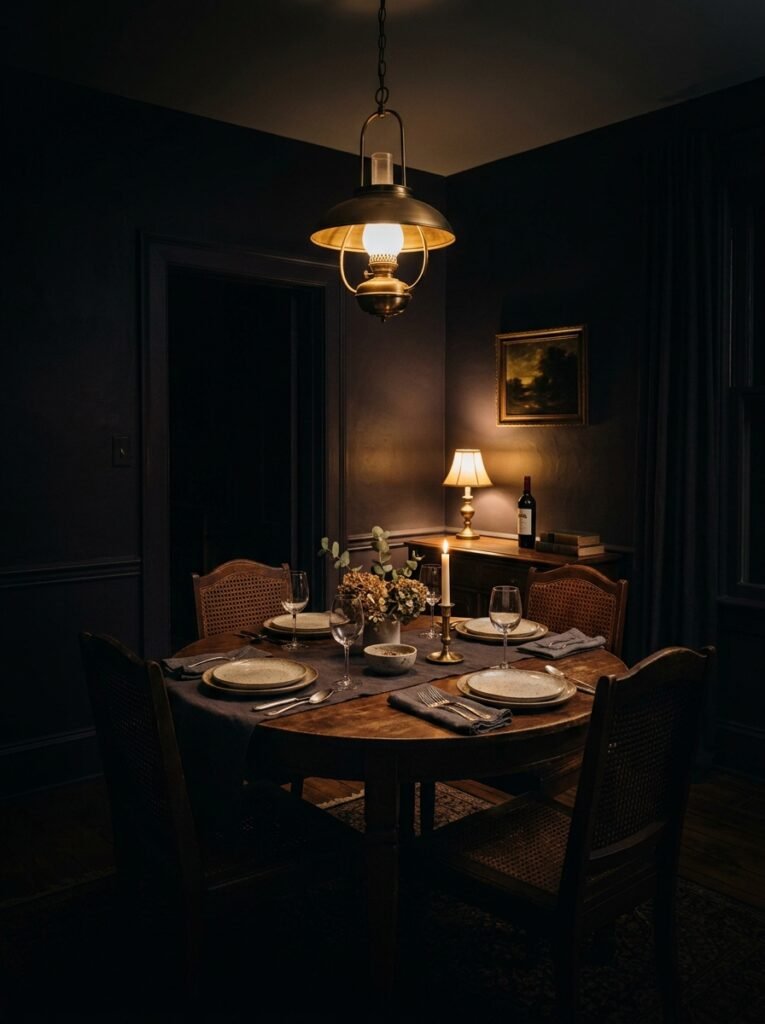
The standard advice for a small room is to keep it pale. In a dining room that advice is answering the wrong question, because it assumes daylight.
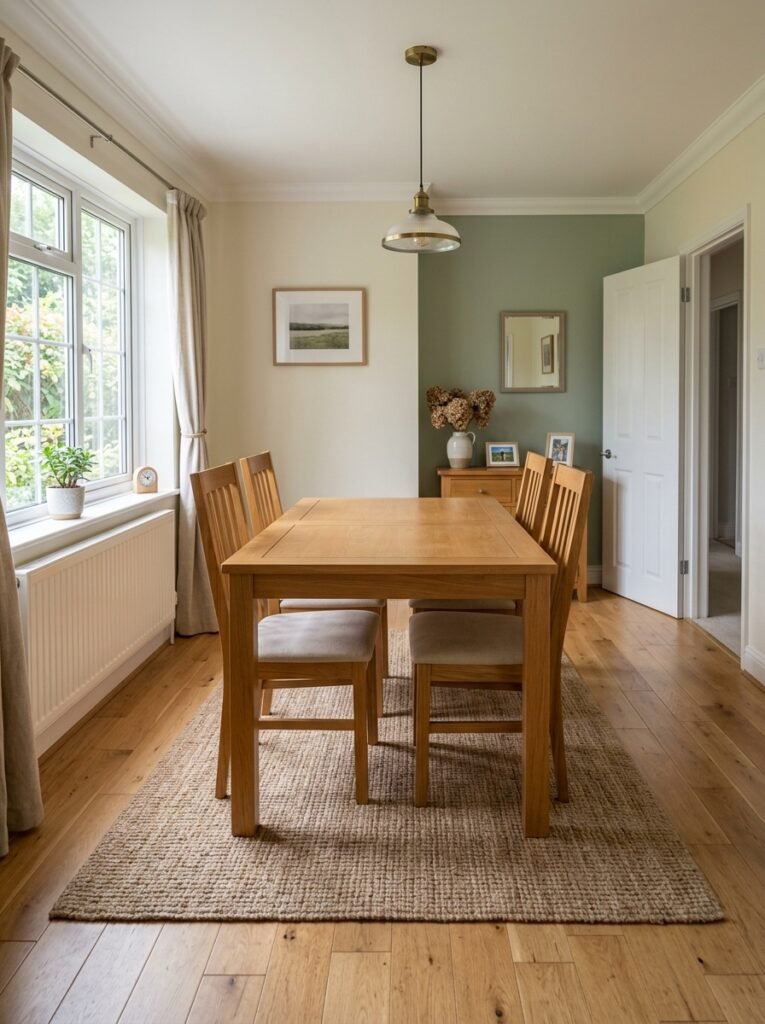
A small dining room used mainly in the evening gets judged under lamplight, not sunlight. Dark walls under warm light do something pale walls cannot. The corners stop being visible, so the room loses its boundary rather than announcing it.
Take the color across the walls and the woodwork rather than stopping at a picture rail. Contrast is what makes a room read small, not depth of color. A dark wall with white trim, white ceiling and white skirting draws four hard lines around the space. Those lines hand the eye a measurement.
Finish does real work here. A matte or eggshell dark absorbs light softly and holds the enveloping quality. A gloss finish reflects every bulb as a hard bright point, which undoes the effect entirely.
The one exception: if the room gets good daylight and is genuinely used for lunch, this flips. Most dining rooms are not in that position.
The Ceiling Is the Surface Everyone Is Looking At
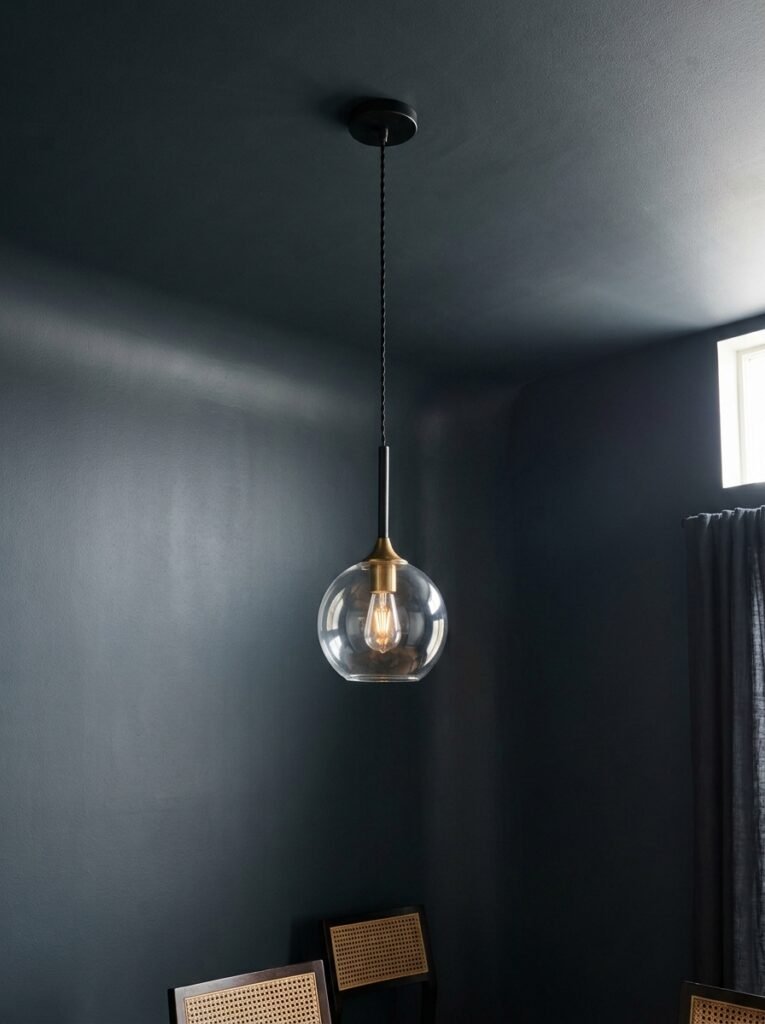
Dining is the only activity where everyone sits still, facing slightly upward, for an hour at a time.
In every other room the ceiling gets glanced at on the way past. At a dining table it sits in the field of view of every person there. That makes it the most overlooked high-impact surface in the house.
The cheapest version costs one extra tin of paint. Carry the wall color across the ceiling and the line where the two meet disappears. Without that line the eye stops registering the room’s height as a limit. The whole space reads taller and more finished.
More ambitious versions work here too. A papered ceiling, or a tone a shade deeper than the walls, both land well in a room this size.
There is a practical reason it succeeds. Nobody touches a ceiling. A delicate paper or a chalky finish survives up there. On a wall behind pushed-back chairs it never would.
Build the Seating Into the Wall
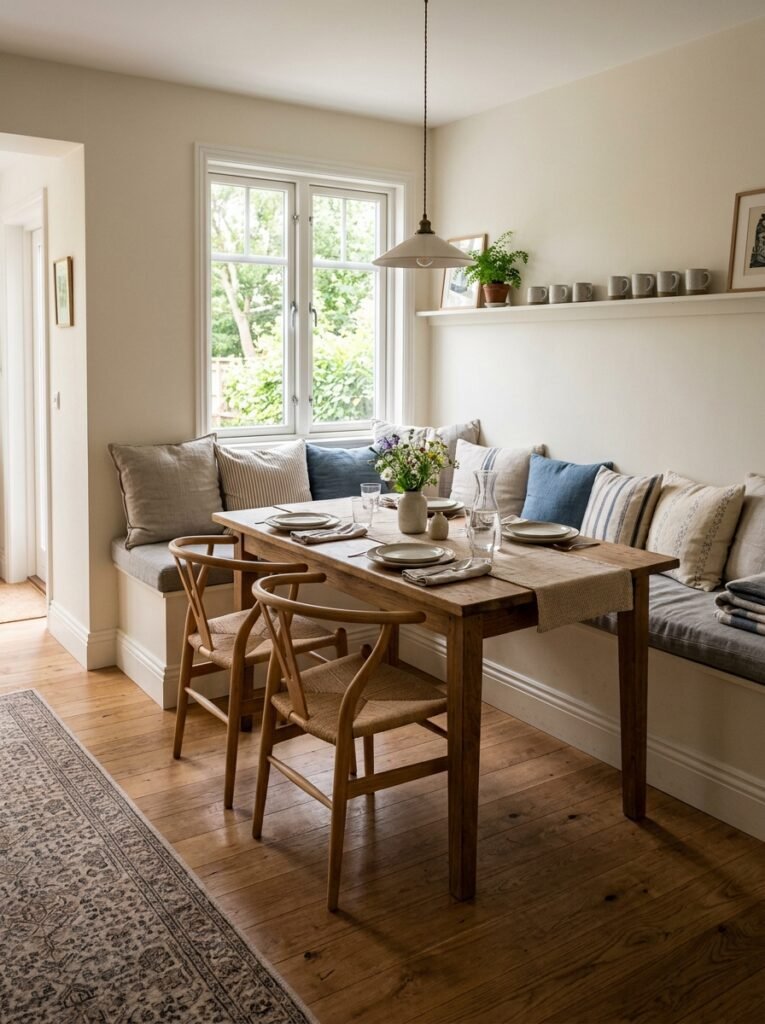
This is the single largest space gain available in a small dining room, and it is geometry rather than decoration.
A chair needs clear floor behind it to be pulled out and sat down in. A bench needs none, because people slide in from the end. That reclaims a strip of floor along one wall. In a tight room that strip is often the difference between a table that fits and one that does not.
A few things make the difference between a bench that gets used and one that gets avoided:
- Put the bench on the wall side and keep chairs on the open side. A bench on both sides makes reaching the middle seats genuinely awkward
- Give it something to lean against. A bench with no back, against no wall, gets abandoned within a month
- Add a real cushion. Bare timber is fine for ten minutes and nobody lingers past that
- Built-in versions can hold storage under the seat, though a freestanding bench captures most of the floor gain on its own
Questions Before Committing to Anything Bold
Will a dark color make a small dining room feel smaller? Not when it is used consistently across surfaces. What shrinks a room is contrast between surfaces, not the depth of the color itself.
What if my dining area is part of another room? Then most of this does not apply. The space is on show all day and shares light with a room used far more heavily. That situation runs on completely different rules, covered in this piece on dining areas that are not really rooms.
Is a banquette worth the cost? If the room is genuinely tight, yes, because it buys floor space that no amount of decorating can produce. If the table already fits with room to spare, it becomes a comfort choice rather than a spatial one.
Can a small dining room take patterned wallpaper? It is one of the best rooms in the house for it, for the occupancy reason. Larger-scale patterns generally suit small rooms better than tiny busy repeats, which read as texture from across a table anyway.
How do I stop a dark room feeling like a cave? Keep one reflective element in the scheme and make sure the light is warm and dimmable. A completely matte, completely dark room lit by one bright fixture is where this goes wrong.
The Wall Everyone Faces
Because everyone sits facing inward, the walls in a dining room are not worth the same as each other. Each person spends the meal looking at the wall opposite them, with their back to the one behind.
That has a clear consequence. Put the strongest single thing in the room on the wall that faces the main seating position. One large artwork, one panel of mural paper, a collection of plates, a mirror. The wall behind a banquette can stay completely plain, because it spends every evening behind people’s heads.
Hanging height needs adjusting too. Everything in a dining room should be hung for a seated eye line. That sits lower than in any other room in the house. Art hung at standing height ends up floating above the conversation.
One more view is worth checking. Stand in the doorway, because that is how the room looks for the twenty-three hours nobody is sitting in it.
Mirrors, and Where They Actually Belong
A mirror in a small dining room is a cliché that happens to work. Placement is what decides whether it does anything.
Position it to reflect a light source, a window or the candles. A mirror reflecting the blank wall opposite simply doubles a blank wall. That is the most common way this idea fails.
Facing the table directly is worth avoiding. Diners spend the meal watching themselves eat, which a surprising number of people find uncomfortable once they notice it.
At night the real payoff arrives. A mirror positioned near candlelight doubles the number of flames in the room. That is the real argument for one here, rather than any general small-space rule.
Antique or lightly foxed glass reflects more softly. It avoids the flat gym-mirror quality a large modern mirror can bring to a small room.
What Cannot Be Creative
One part of a small dining room has no room for expression at all. It is also the part everyone underestimates.
Getting in and out has to work in low light, after a drink, while carrying something hot. That rules out a few things regardless of how good they look. No rug with edges that lift. No trailing cable from a floor lamp. And the door has to clear the nearest chair while somebody is sitting in it.
Candles need the same discipline, particularly in a small room where the table edge sits close to curtains. The National Fire Protection Association’s guidance on candles is worth following exactly. Sturdy holders on a sturdy, uncluttered surface. Kept well clear of anything that can burn, and put out whenever the room empties.
A small dining room is precisely the situation that guidance is written for. The distance from a centerpiece to a curtain is often measured in inches. Flameless candles give most of the same light for anyone who wants the look without the calculation.